
Mozambican Graphite, American Batteries
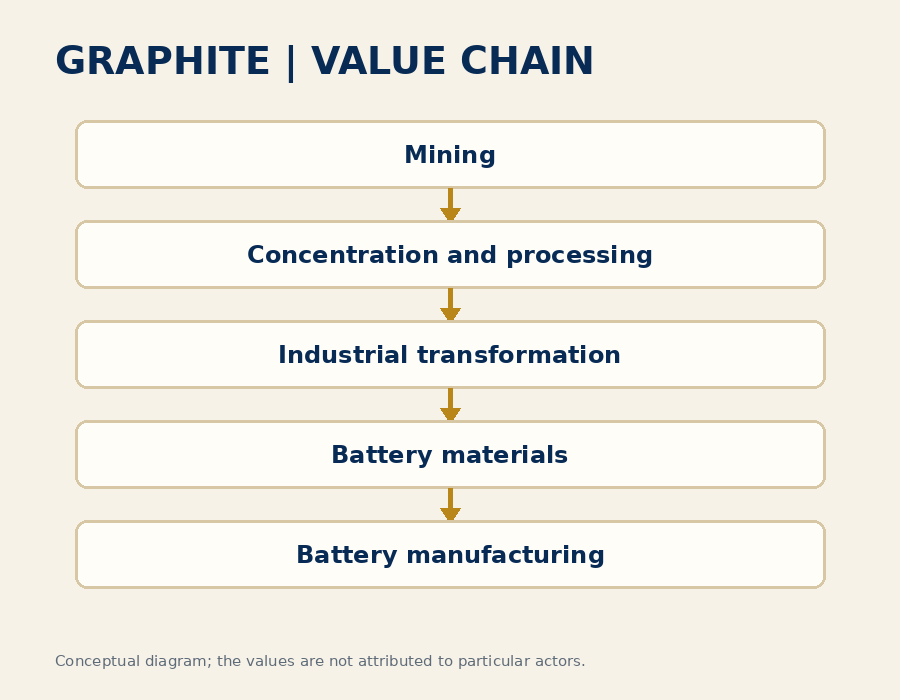
At Balama, in northern Mozambique, miners extract graphite from the ground. The mineral is part of an industrial chain, with one outlet in Louisiana. On 25 March 2026, the US development finance agency, DFC, announced a proposal to restructure its debt exposure and acquire an equity stake in Syrah Resources, the company controlling the Mozambican mine and an anode-materials plant in the United States. At that stage, the proposed transaction did not amount to Washington buying the mine outright. It nevertheless revealed the American government’s priority: securing supplies for its own industries.
How much of this industrial activity, technical expertise and skilled employment will remain in the country where the deposit lies? The same question applies to Congolese cobalt, Zambian copper, lithium, and other minerals over which major powers compete.
Washington Rediscovers Africa as Its Rivals Advance
American interest in African resources has long followed Washington’s geopolitical priorities. During the Cold War, its attention to several African states was driven primarily by the desire to contain Soviet influence and governments aligned with the communist bloc. Security alliances, political support and economic assistance were largely organised around that confrontation. Africa figured in American strategic calculations without becoming the focus of a project to transform the continent’s economy.
Today the rivalry has moved to different ground. China now holds a decisive position in several critical-mineral processing chains. The United States is seeking to reduce that dependence and is turning towards African deposits. It has recognised the urgency of investing where competitors have already built commercial relationships, infrastructure, and industrial capacity. Africa is once again a major strategic concern, less for what it might manufacture than for what the United States needs.
This interpretation does not erase earlier American investment or the cooperative initiatives that have existed. It calls for assessing their significance. Have they transformed African productive structures on a scale commensurate with the continent’s needs? Present announcements do not answer that question.
Competition Between Powers Is Not an Industrial Policy
Two powerful buyers can improve producer countries’ negotiating position. It can also trap them in a competition over extraction contracts, with each agreement promising more volume, concessions and export facilities. The ore leaves, revenue comes in, and factories, laboratories and patents remain concentrated in the economies that process the raw material.
The Lobito Corridor, supported in particular by the United States, illustrates this ambiguity. By connecting mining areas in the DRC and Zambia more efficiently to the Angolan port, it can reduce transport costs and support regional trade. Yet a railway that speeds up copper or cobalt exports does not, by itself, guarantee the emergence of metallurgy or component manufacturing in Africa. The infrastructure's economic purpose depends on what is built around it.
African Minerals Sought by the United States, African Migrants Sent Back: A Strange Trade
As Washington steps up efforts to access African resources, its administration is also pursuing a deportation policy affecting African nationals and arranging transfers to countries on the continent of which those individuals are not necessarily citizens. In a report published on 8 October 2026, Human Rights Watch documented several such arrangements and their consequences for those concerned.
Minerals are treated as indispensable to American economic security, while migrants are seen as a problem to be removed from American territory. The same agencies do not administer the two policies, nor do the same legal instruments govern them. Their coexistence nevertheless illuminates the relationship being offered to Africa. Its resources are sought, while its people are not necessarily accorded an equivalent place in the movement of persons or in defining common interests.
Washington presents its investments as partnerships. African countries are entitled to ask what those partnerships change in their capacity to manufacture, employ and train their populations.
Africa Cannot Remain a Supplier to Other Countries’ Industrialisation
The American need to diversify its supplies creates an opportunity to negotiate. It does not spontaneously provide a development strategy for Africa. No foreign government will build African industry out of mere goodwill. Producer states, however, can refuse to separate access to their deposits from the creation of local industrial capacity.
This requires choices extending beyond individual concessions. Mineral processing consumes energy and depends on reliable infrastructure, long-term finance, regional markets and sustained technical training. African countries rarely possess all these conditions individually. Cooperation could give them bargaining power that their present fragmentation weakens.
America’s return to African mining raises the question of where wealth will ultimately be created. If the rivalry between Washington and Beijing merely increases export volumes, producer countries will have served as conduits for two foreign industrial strategies without building their own. The continent has no reason to accept indefinitely the supplier’s role that each new power asks it to continue playing.