
WhatsApp and Spelling in Academic English: Evidence from First-Year Bilingual Studies Students at the University of Yaoundé I
Date de publication :
Résumé
Les étudiants passent aujourd’hui une grande partie de leur temps à écrire sur des applications de messagerie mobile, WhatsApp en tête, et les enseignants redoutent que les abréviations, les formes raccourcies et les orthographes phonétiques du « chat » ne se retrouvent dans les devoirs formels. Cet article examine la relation entre l’usage de WhatsApp et l’orthographe dans l’anglais écrit des étudiants de Niveau 1 du Département d’Études Bilingues de l’Université de Yaoundé I. Une étude de cas à méthodes mixtes a combiné un questionnaire administré à 126 étudiants et une analyse de contenu de 70 devoirs écrits. Le questionnaire révèle un usage intensif : plus de la moitié des répondants utilisent WhatsApp chaque jour, la plupart entre une et six heures, souvent en français ou en langues mêlées. Les devoirs ont livré 198 erreurs d’orthographe, dominées par la substitution (26,26 %), l’omission (22,22 %) et l’addition (14,14 %) ; les formes typiques du chat (bby, cuz, clippings, sigles, argot) forment un groupe plus restreint mais révélateur (environ 15 %). Les étudiants eux-mêmes tendent à nier tout effet négatif de WhatsApp sur leur orthographe. L’article propose de lire WhatsApp comme un environnement linguistique à double tranchant, dont l’effet dépend de la conscience des registres, et formule des recommandations pédagogiques.
Abstract
Students now spend a large share of their day writing on mobile messaging applications, WhatsApp above all, and teachers worry that the abbreviations, shortened forms and phonetic spellings of chat travel into formal assignments. This article examines how WhatsApp use relates to spelling in the written English of Level 1 students of the Department of Bilingual Studies at the University of Yaoundé I. A mixed-methods case study combined a questionnaire administered to 126 students with a content analysis of 70 written assignments. The questionnaire shows intensive use: more than half of respondents use WhatsApp every day, most for between one and six hours, and many in French or in mixed languages. The assignments yielded 198 spelling errors, dominated by substitution (26.26%), omission (22.22%) and addition (14.14%); features that are unmistakably typical of chat, such as abbreviations (bby, cuz), clipping, initialisms and slang, form a smaller but telling group (about 15%). Students themselves tend to deny that WhatsApp harms their spelling and often credit it with improving their English. The article argues that WhatsApp is best read as a double-edged linguistic environment whose effect depends on register awareness, and it proposes pedagogical measures for students, lecturers and university authorities.
1. Introduction
Digital communication has changed what it means to write. Instant messaging, texting and social media have produced a pervasive form of everyday written language that prizes speed, brevity and interactivity (Crystal, 2001; Tagliamonte & Denis, 2008). Its typical features include abbreviations and acronyms, phonetic respellings, emojis and symbols, code-switching and creative departures from standard orthography. These features are harmless, even inventive, in a chat between friends. They become a concern when they appear in contexts where standard spelling and grammatical precision are expected, such as an examination script or a term paper.
Among messaging applications, WhatsApp has become the dominant one for many young people. It lets users exchange text, voice notes, images, documents and links at low data cost, and it supports group conversation with very little friction (Church & de Oliveira, 2013). At the University of Yaoundé I, it is part of the academic routine: students use it to share lecture notes, receive announcements, coordinate group work and keep up peer networks. The same application is therefore both a learning aid and a daily exposure to non-standard written English.
This double role explains why the literature on WhatsApp in education is divided. Several studies report favourable student attitudes towards WhatsApp as a tool for interaction, collaboration and the sharing of learning materials (Awada, 2016; Gasaymeh, 2017; Ferreira-Meyers & Martins, 2020). Others warn that constant exposure to informal writing may erode orthographic accuracy and blur the boundary between formal and informal registers (Tagliamonte & Denis, 2008). The question is particularly pressing in Cameroon, a multilingual country where English has held an important position since 1922 and where weaknesses in learners’ English, orthography included, have been documented repeatedly. Achiri and Lando (2017), for instance, report that 90% of the learners they surveyed struggled with orthography. Whether WhatsApp adds to these difficulties among university undergraduates has received little empirical attention.
This article addresses that gap. It reports a case study of Level 1 students in the Department of Bilingual Studies at the University of Yaoundé I, chosen because first-year students are heavy WhatsApp users who are still acquiring the conventions of academic writing. It is guided by four questions:
- How does WhatsApp use relate to the spelling accuracy of Level 1 students in their written English assignments?
- To what extent does WhatsApp use appear to influence spelling in formal written English?
- Which specific spelling errors and language patterns in the assignments can plausibly be linked to WhatsApp?
- What do these patterns imply for students’ academic performance in English and for the teaching of writing?
The scope is deliberately narrow. The study concerns spelling (orthography) in written English assignments and does not treat grammar, punctuation or vocabulary. The article is organised as follows: Section 2 sets out the conceptual and theoretical background, Section 3 describes the method, Section 4 reports the findings, Section 5 discusses them and states the limitations of the study, Section 6 draws pedagogical implications, and Section 7 concludes.
2. Conceptual and theoretical background
2.1 WhatsApp as a language environment and a learning tool
Computer-mediated communication has given rise to new written varieties, labelled “netspeak”, “textese” or “internet slang” (Baron, 2010; Crystal, 2001). Crystal (2008) uses the term textisms for the non-standard forms, such as abbreviations, letter–number homophones and shortened spellings, that help writers type faster and keep a conversation flowing. WhatsApp falls squarely within this territory: it is at once a social tool and a space of linguistic innovation. Its voice-note function adds an oral dimension to what is otherwise a written medium, and its emojis supply the paralinguistic cues that plain text lacks.
WhatsApp is also widely used for teaching and learning. Group chats allow instructors to circulate materials, give feedback and manage a class remotely, and they allow learners to practise reading and writing, ask questions and work together (Awada, 2016; Bouhnik & Deshen, 2014). The pandemic period intensified these uses in Cameroon, as institutions turned to online and mobile solutions; Nkemleke and Lényuy (2025) document WhatsApp-based learning at the École Normale Supérieure de Yaoundé during that time. The same studies that praise WhatsApp as a learning tool, however, also note that it cannot be separated from the informal habits that surround it.
2.2 The Cameroonian setting
Cameroon is a highly multilingual country in which English has held an important position since 1922 and serves as a language of prestige and social mobility. A body of research, however, points to declining standards of English among learners, especially in orthography, punctuation, sentence construction and pronunciation. The figures reported by Achiri and Lando (2017) give an idea of the scale: 90% of learners struggling with orthography, 82.5% with punctuation, 75% with pronunciation, 70% with capitalisation and 67.5% with sentence construction. Any investigation of WhatsApp and spelling must therefore start from the fact that weak spelling in English long predates the smartphone. The relevant question is not whether WhatsApp creates spelling problems from nothing, but whether it feeds, reinforces or makes visible problems that are already there, in a context where students also move constantly between English, French and other languages.
2.3 Theoretical anchors
The study draws on four complementary frameworks. Computer-Mediated Communication (CMC) theory supplies the main premise: the technology through which people communicate shapes the language they produce. A fast, informal, typing-based medium encourages economy of expression, and repeated exposure to such forms may influence writers’ habits in other settings.
Communication Accommodation Theory (CAT) explains why such forms spread. According to Giles and Ogay (2007), speakers adjust their style to the people they interact with. In peer chats, students converge on shared abbreviations and spellings, which then become normalised within the group and may surface unnoticed in formal writing.
Error Analysis provides the method for describing what students actually write. Following Corder (1967), learners’ errors are treated not as mere failures but as systematic evidence of the knowledge they are building. Errors can be collected, classified and counted, and their patterns interpreted. Language Transfer completes the picture. Developed in the interlanguage tradition (Selinker, 1972), it holds that habits acquired in one linguistic setting can carry over into another, whether from a first language to a second or, by extension, from an informal digital register to a formal academic one.
2.4 A contested research field
Earlier research on texting and literacy has not produced a simple verdict. Work on young people’s text messaging has documented abundant textism use (Thurlow & Brown, 2003) and has asked directly whether text abbreviations adversely affect literacy attainment (Plester et al., 2008; Kemp et al., 2016). Some scholars argue that a heavy flow of informal writing may encourage efficiency over accuracy and reduce proofreading (Tagliamonte & Denis, 2008); others point out that choosing which elements to abbreviate depends on context and can itself sharpen metalinguistic awareness. On this second view, what matters is not the application but the user’s ability to match language to situation, a point Baron (2010) makes when she stresses that the effects of technology depend largely on how it is used.
Two gaps follow. First, much of the evidence comes from outside Africa and from younger learners. Second, studies of the Cameroonian university context rarely examine students’ actual written output alongside their self-reported WhatsApp habits. The present study combines both.
3. Methodology
3.1 Design and participants
The study is a mixed-methods case study. A case study design suits an in-depth examination of a specific group in its real academic context, and it allows several instruments to be combined. The target population was all Level 1 students enrolled in the Department of Bilingual Studies at the University of Yaoundé I during the 2025–2026 academic year. Purposive sampling was used to select students who actively use WhatsApp and regularly produce written work in English. Purposive sampling is a non-probability technique, so the findings describe this group and cannot be statistically generalised to all Cameroonian undergraduates.
3.2 Instruments and procedure
Two instruments were used. A questionnaire was administered to 126 Level 1 students. It covered personal information, WhatsApp use (frequency, daily duration, language used, use of abbreviations), the perceived relationship between WhatsApp and spelling, students’ opinions on a series of statements, and open-ended questions. In addition, written English assignments were collected from 70 students on a set topic. The scripts were read closely, and every spelling error was identified, coded and classified.
3.3 Analysis
Questionnaire data were coded and summarised with descriptive statistics (frequencies and percentages) and presented in tables and charts. The assignments were analysed through content analysis in the Error Analysis tradition. Each error was assigned to a category, defined with reference to the literature (for example, Thurlow & Brown, 2003, and Crystal, 2001, 2008, for orthographic deviations, and Selinker, 1972, for interlingual errors), and the relative frequency of each category was computed as a percentage of the total corpus of 198 errors. The two data sets were then compared to see whether self-reported habits and observed written output pointed in the same direction.
3.4 Ethical considerations
Participation was voluntary and informed consent was obtained. Responses and scripts were anonymised and coded. No private WhatsApp conversations were accessed; participants only reported the kinds of spelling they habitually use. Permission to collect data was obtained from the department, and the data were used solely for this research.
4. Findings
4.1 Profile of WhatsApp use
Table 1 summarises the main features of respondents’ WhatsApp use. Most respondents were between 19 and 21 years old (42.47%), followed by those aged 16–18 (23.97%), with only a small proportion above 22, and female students were the majority. This is the age group in which social media use is heaviest. No respondent reported being a non-user of WhatsApp.
Table 1. Selected features of respondents’ WhatsApp use
| Feature | Result | Remark |
|---|---|---|
| Age 19–21 years | 42.47% | Largest age group |
| Age 16–18 years | 23.97% | Second largest group |
| Use WhatsApp every day | 56.85% | More than half of respondents |
| Daily time on WhatsApp | 1–6 hours (most) | A significant share exceeds six hours |
| Main language on WhatsApp: French | 39.04% | Most frequent single language |
| Main language on WhatsApp: mixed languages | 25.34% | Reflects code-switching |
| Main language on WhatsApp: English | 9.59% | Minority choice |
Source: questionnaire data (author’s fieldwork).
Two points stand out. First, exposure is intensive: more than half of the respondents use the application daily and most spend between one and six hours a day on it. Second, the language of exchange is overwhelmingly not English. French (39.04%) and mixed languages (25.34%) far outweigh English (9.59%), which fits the bilingual and multilingual setting of Cameroon. Frequent switching between languages offers an obvious opportunity for interference, and it means that for many students the most-practised informal writing is not English at all. Many respondents also admitted using abbreviations when chatting. The open-ended answers named forms such as U, OMG, IDK, Bjr, Stp and Cc, and gave a consistent reason: abbreviations save time and make communication fast.
4.2 Students’ own perceptions
Students’ views of the effect of WhatsApp on their spelling were more reassuring than might be expected (Table 2). More than half reported that WhatsApp had not influenced their spelling in English assignments. Among those who acknowledged an influence, most described it as positive, although some reported negative or mixed effects. Most respondents said they never or only sometimes make spelling mistakes in assignments because of WhatsApp habits. More than half believed WhatsApp improves their English spelling, citing new vocabulary, practice in English and the help of predictive text and autocorrect. Most disagreed that it worsens their spelling, and most said they do not find it hard to switch from WhatsApp language to formal academic English.
Table 2. Students’ perceptions of WhatsApp and spelling (summary of questionnaire results)
| Questionnaire item | Pattern of responses |
|---|---|
| Has WhatsApp influenced your spelling in English assignments? | More than half said it has not; among those who said it has, most described the influence as positive |
| Do you make spelling mistakes in assignments because of WhatsApp habits? | Most answered “never” or “sometimes” |
| Does WhatsApp improve your English spelling? | More than half believed it does |
| Does WhatsApp worsen your English spelling? | Most disagreed |
| It is difficult to switch from WhatsApp language to formal academic English | Most disagreed |
| Students should avoid excessive use of abbreviations | Many agreed |
Source: questionnaire data (author’s fieldwork). Response patterns are reported as in the dissertation.
At the same time, students were not naive about risk. Many agreed that students should avoid excessive use of abbreviations, and when asked how to limit harm they proposed concrete strategies: reducing abbreviations, reading books regularly, consulting dictionaries, practising formal writing, using educational applications and consciously separating chat language from academic language. In their own account, then, WhatsApp is neither a culprit nor a cure; what matters is how it is used.
4.3 The error corpus
The analysis of the assignments identified 198 spelling errors, which were classified into fifteen categories. Figure 1 shows their distribution, and Table 3 gives definitions, counts and illustrative examples drawn from the corpus.
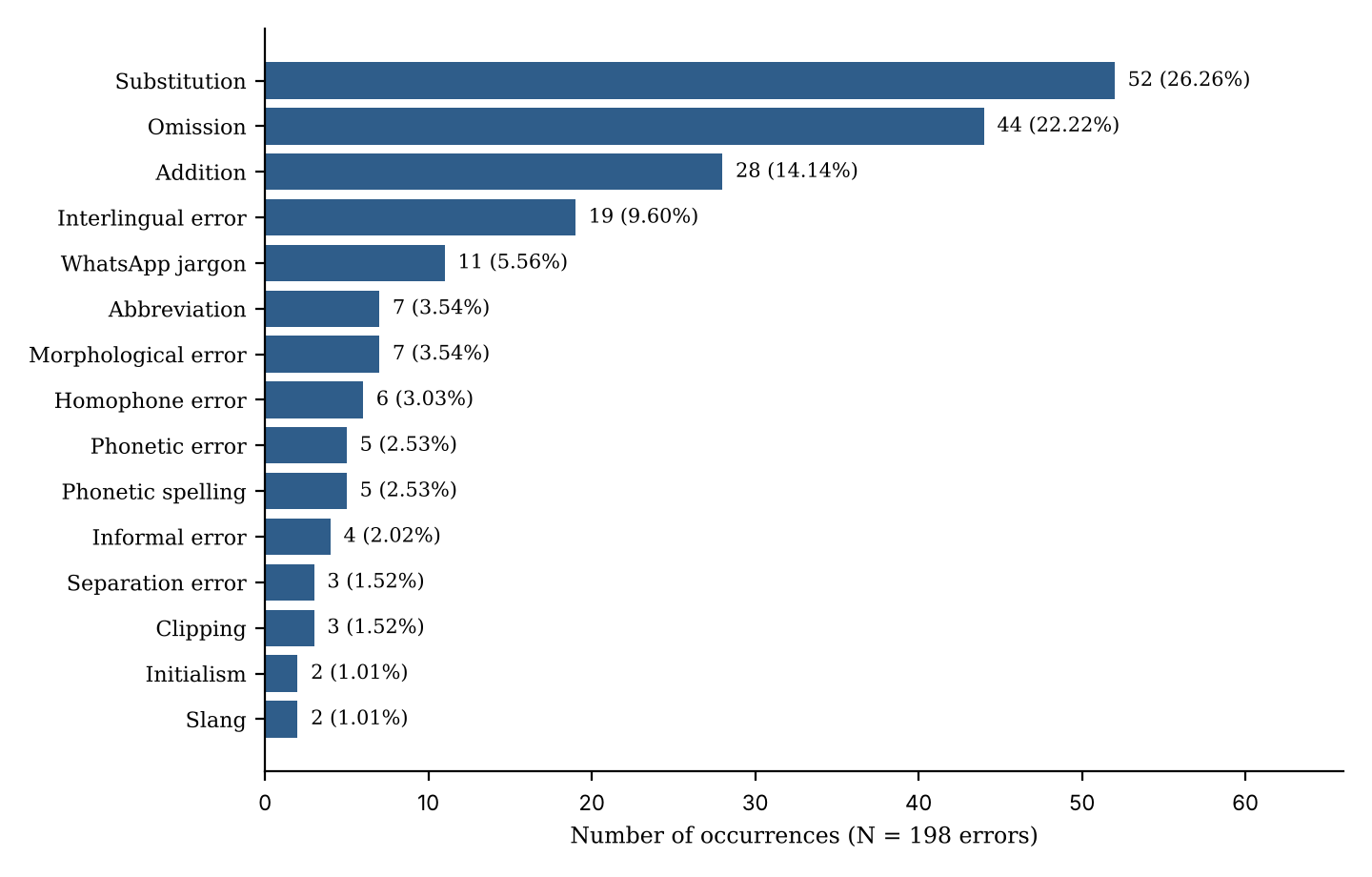
Table 3. Error categories, frequencies and illustrative examples (error → standard form)
| Category | N | % | Examples (error → standard form) |
|---|---|---|---|
| Substitution | 52 | 26.26 | fild → field; nise → nice; mervellous → marvellous; studie → study |
| Omission | 44 | 22.22 | fist → first; requiement → requirement; Mathematic → Mathematics |
| Addition | 28 | 14.14 | verry → very; hight → high; welcomme → welcome |
| Interlingual error | 19 | 9.60 | Bibliotheque → library; geographie → geography; departement → department |
| WhatsApp jargon | 11 | 5.56 | hummm → hmm (hesitation marker) |
| Abbreviation | 7 | 3.54 | bby → baby; cuz → because; diff → different; bro → brother |
| Morphological error | 7 | 3.54 | sudenly → suddenly; lets → let’s; it’s → its |
| Homophone error | 6 | 3.03 | no → know; hear → here; new → knew |
| Phonetic error | 5 | 2.53 | waouh → wow; epoustoufly → astonishing |
| Phonetic spelling | 5 | 2.53 | sweatie → sweetheart; Minuit → midnight |
| Informal error | 4 | 2.02 | hahaha (laughter); mom → mother |
| Separation error | 3 | 1.52 | to day → today; good bye → goodbye |
| Clipping | 3 | 1.52 | amphi → amphitheatre; cause → because |
| Initialism | 2 | 1.01 | RIP → rest in peace; bb → bye-bye |
| Slang | 2 | 1.01 | babe (endearment); bro → brother / friend |
| Total | 198 | 100 |
Source: analysis of 70 written assignments (author’s fieldwork).
The three “core” orthographic categories lead clearly. Substitution (52 occurrences; 26.26%) covers the replacement of a letter by another while the word remains recognisable. Omission (44; 22.22%) is the deletion of one or more letters, and addition (28; 14.14%) the insertion of superfluous ones. Next come interlingual errors (19; 9.60%), where French forms are carried over into English (bibliotheque, geographie, departement), a reminder that in this bilingual setting the other language is a source of interference alongside the chat register. WhatsApp jargon follows with 11 occurrences (5.56%), then abbreviations and morphological errors at 7 each (3.54%) and homophone errors at 6 (3.03%). The remaining categories (phonetic errors and spellings, informal forms, separation errors, clipping, initialisms and slang) each account for between 1% and 2.6% of the corpus.
For the purposes of interpretation, the fifteen categories can be regrouped into five families, as shown in Table 4. This regrouping is an analytical step taken for this article and uses only the counts above.
Table 4. Error families (regrouping of the 15 categories)
| Family | Categories included | N | % of 198 |
|---|---|---|---|
| General orthographic deviation | Substitution, omission, addition | 124 | 62.63 |
| Interlingual transfer | Interlingual errors (L1/French forms) | 19 | 9.60 |
| Chat-register features | WhatsApp jargon, abbreviation, informal error, clipping, initialism, slang | 29 | 14.65 |
| Sound-based spellings | Homophone error, phonetic error, phonetic spelling | 16 | 8.08 |
| Morphology and word division | Morphological error, separation error | 10 | 5.05 |
Source: author’s regrouping of the counts in Table 3.
This regrouping matters for what can be claimed. The largest family, general orthographic deviation (62.63%), consists of the kinds of slips that any learner of English can make, with or without a smartphone. The family that is most diagnostic of digital writing, the chat-register features, is much smaller (29 errors; 14.65%) but also the most telling, because forms such as bby, cuz, bro, RIP, amphi and repeated laughter strings (hahahahaha) have no place in academic prose and are standard currency in chat. Sound-based spellings (8.08%) occupy an intermediate position, since they can reflect both chat habits and weak knowledge of English sound–spelling correspondences.
4.4 Reading the main categories in detail
Substitution, omission and addition. These three categories describe what happens at the level of the individual letter. Substitution replaces one letter by another, so that field becomes fild, nice becomes nise and marvellous becomes mervellous. In several of these cases the substituted letter yields a spelling that reproduces the pronunciation rather than the conventional form, which is also the logic of phonetic respelling in chat. Omission shows the opposite tendency to economy: letters disappear, as in fist for first, requiement for requirement and Mathematic for Mathematics. Addition runs the other way, with doubled or superfluous letters (verry, hight, welcomme). Together these patterns suggest unstable control over the internal structure of English words, and, in some instances, writing done quickly and without proofreading, a condition WhatsApp encourages but does not create.
Interlingual errors. The 19 interlingual errors (9.60%) show French words written in the French form where English was required: bibliotheque for library, geographie for geography, traduction for translation, departement for department, selectif for selective and coin for corner. This is negative transfer in the sense of Selinker (1972). It matters for the interpretation of the whole corpus because it shows that a share of the errors comes from the bilingual repertoire of the students, which the questionnaire confirms is very active on WhatsApp: French and mixed-language use together account for roughly two-thirds of respondents’ stated language choices.
Chat-register features. The 29 errors in this family are the most direct signs of digital habits. Abbreviations (bby, cuz, diff, bro) and initialisms (RIP, bb) are conventions for saving keystrokes. Clipped forms (amphi, cause) shorten words in the way speakers do informally. Slang (babe, bro) and jargon such as hummm, a typed hesitation marker, import the conversational tone of chat, while strings such as hahaha stand in for laughter. None of these is a spelling error in chat, since each is understood by its audience; they become errors only because the register is wrong for the task. This is the crux of the matter: such forms are not signs of ignorance of English but of the failure, on some occasions, to apply the norms of the academic register.
Sound-based spellings. Homophone errors (no for know, hear for here, new for knew), phonetic errors (waouh for wow) and phonetic spellings (sweatie, Minuit) all rely on sound as a guide to spelling. They overlap with chat practice, where respelling by sound is a standard device, but they are also typical of learners whose knowledge of English sound–spelling correspondences is incomplete. For this reason they are best treated as an ambiguous category, where chat habits and general proficiency probably both play a part.
5. Discussion
5.1 Exposure and habit formation
The usage data show the conditions under which habits form. Frequency of exposure to a linguistic environment increases the likelihood that its patterns will be adopted, and these students are exposed daily and for hours at a time. This is consistent with CMC theory and with Crystal’s (2008) account of textisms as forms generated by the pressure for speed. It also fits CAT: since the abbreviations that respondents named (U, OMG, IDK, Bjr, Stp, Cc) are shared conventions of a peer group, using them is partly a way of belonging, and conventions that signal belonging are exactly the ones that become automatic.
5.2 Evidence of transfer
The most direct evidence of transfer is the presence in academic scripts of forms that belong to chat: abbreviations, clipped words, initialisms, slang, laughter strings and jargon. Unlike substitution or omission, these cannot easily be explained by general language difficulty. Their appearance suggests that some students do not consistently switch register when they move from a conversation with friends to a graded assignment. This supports the Language Transfer perspective and echoes the concern, voiced across the literature, that informal habits leak into formal writing.
The other categories call for more caution. Substitution, omission and addition together make up almost two-thirds of the corpus, but the design of the study does not allow these errors to be attributed to WhatsApp specifically. They may reflect typing habits, limited attention to word form, inadequate command of English orthography or the influence of French. The interlingual errors are a clear example: bibliotheque and departement are products of the French–English cognate relationship and need no help from WhatsApp. A responsible reading is therefore that the corpus is consistent with some WhatsApp influence, concentrated in the chat-register family, rather than proof that WhatsApp is the main cause of students’ spelling errors.
5.3 A gap between perception and performance
A notable result is the contrast between what students say and what they write. In the questionnaire, most respondents said that WhatsApp has little or no negative effect on their spelling, that they seldom make WhatsApp-related mistakes and that they can switch registers without difficulty. Yet their assignments contain chat-register forms that most of them would presumably recognise as inappropriate if asked. Two explanations are plausible and are not mutually exclusive. The first is habit formation: behaviours repeated often become automatic, so that awareness of a norm does not guarantee compliance when writing quickly. The second is a self-report bias, since students may underestimate the extent to which informal forms slip into their work. Either way, awareness alone does not appear sufficient, which is why the pedagogical implications below emphasise practice and feedback rather than exhortation.
5.4 A double-edged tool
The positive contributions of WhatsApp should not be lost in the discussion of error. Respondents credit it with more frequent communication in English, exchange of academic information, new vocabulary, participation in group discussion and collaboration on assignments. These benefits agree with studies of WhatsApp as a learning platform (Awada, 2016; Bouhnik & Deshen, 2014; Gasaymeh, 2017) and with Baron’s (2010) view that technology’s influence depends on how it is used. The evidence of this study therefore supports a balanced position. WhatsApp is not inherently detrimental to academic writing, but it creates conditions in which informal forms can be rehearsed and carried over unless students learn to manage the boundary between registers. The study also found that not all students are equally affected: some keep the registers apart and produce accurate spelling, which suggests that language proficiency, reading habits and self-monitoring moderate the influence.
5.5 Answering the research questions
Returning to the four research questions, the evidence can be summarised as follows. Regarding the first and second questions, WhatsApp use is intensive and the scripts contain features of chat language, which indicates an influence on spelling in formal assignments; the influence appears to be limited in extent, concentrated in particular categories and uneven across students, and the design does not allow its size to be quantified. Regarding the third, the errors that can most plausibly be linked to WhatsApp are abbreviations, clipping, initialisms, slang, informal forms and jargon, with sound-based spellings as a probable secondary contribution. Regarding the fourth, the implications for academic performance are mainly practical: forms that are normal in chat, and therefore invisible to the writer, will be marked as errors by an examiner, so that unmanaged transfer can cost students marks even when their knowledge of English is sound. The remedy lies in teaching students to notice and control the boundary between registers.
5.6 Limitations
Several limitations qualify these conclusions. Sampling was purposive and confined to one department and one level, so the results cannot be generalised. The design is descriptive: it does not correlate individual students’ WhatsApp use with their own error counts, it has no comparison group of non-users or light users, and it has no baseline measure of the same students’ spelling before heavy WhatsApp use. Spelling errors were counted at corpus level, so it is not known how errors are distributed across the 70 students. Finally, classifying an error as “WhatsApp-related” involves interpretation, and some categories overlap. These limitations do not remove the value of the findings but they define what can be inferred: an association that is plausible and consistent with theory, not a demonstrated causal effect.
6. Pedagogical implications and recommendations
The findings suggest that the right response is neither prohibition nor indifference. WhatsApp is too embedded in students’ academic life to be banned, and the evidence of transfer is too clear to be ignored. The recommendations below follow the study’s results and are grouped by audience.
Students. Learners should consciously separate chat language from academic writing, proofread assignments before submission, read regularly (academic texts and books) to reinforce standard spellings, and use dictionaries and spelling-checking tools. They should limit their dependence on abbreviations, acronyms and phonetic spellings in the settings where these habits are rehearsed most.
Lecturers and teachers. Instruction should make the difference between digital and academic registers explicit, since awareness raised in passing is not enough. Classroom activities that focus on spelling and writing accuracy, regular corrective feedback on spelling, and writing workshops or remedial programmes can all help. Teachers can also turn WhatsApp to advantage by using class groups for activities that model correct written English, and by integrating digital literacy into language teaching so that students practise adapting their language to context.
University authorities. Seminars and awareness campaigns on responsible use of social media for academic purposes, strengthened academic support centres for students with writing difficulties, language enhancement programmes in spelling and academic communication, and educational WhatsApp groups that promote correct language use would address the issue at institutional level.
Policymakers. Digital literacy and online communication awareness could be integrated into university curricula, with greater emphasis on academic writing and spelling instruction in higher education, and with guidelines on appropriate language use in academic and digital learning environments.
7. Conclusion
This article set out to establish how WhatsApp use relates to spelling in the written English of Level 1 students of Bilingual Studies at the University of Yaoundé I. The questionnaire shows heavy, daily, largely non-English use of the application and routine use of abbreviations. The 198 errors identified in 70 assignments are mostly general orthographic deviations, but a distinct and recognisable group of chat-register forms (about 15%) shows that informal digital habits do appear in academic writing. Students, for their part, tend to believe that WhatsApp has little negative effect on their spelling and may even help it, a belief that the scripts only partly bear out.
The study therefore supports a nuanced reading. WhatsApp is both a useful tool for communication and collaboration and a medium that rehearses non-standard spellings, and what determines the outcome is the user’s ability to match language to context. The practical task for educators is accordingly to build that ability through explicit teaching of register, regular spelling practice and feedback, and guided, responsible use of the platform.
Further research should test the relationship more rigorously, for example by linking individual students’ usage profiles to their own error counts, comparing heavy and light users, and following the same students over time. Studies could also extend the analysis beyond spelling to grammar, punctuation, vocabulary and sentence construction, examine the positive contributions of WhatsApp to vocabulary acquisition and collaborative learning, and evaluate the effect of digital literacy training on students’ ability to keep standard English spelling while benefiting from mobile communication technologies.
References
Achiri, S., & Lando, A. (2017). English in Cameroon: Issues of teacher language proficiency. International Journal of English Language Teaching, 44(1), 20–31.
Awada, G. (2016). Effect of WhatsApp on writing proficiency and perceptions toward learning. [Full publication details to be completed.]
Baron, N. S. (2010). Always on: Language in an online and mobile world. Oxford University Press.
Bouhnik, D., & Deshen, M. (2014). WhatsApp goes to school: Mobile instant messaging between teachers and students. [Full publication details to be completed.]
Church, K., & de Oliveira, R. (2013). What’s up with WhatsApp? Comparing mobile instant messaging behaviors with traditional SMS. [Full publication details to be completed.]
Corder, S. P. (1967). The significance of learners’ errors. International Review of Applied Linguistics in Language Teaching, 5(4), 161–170.
Crystal, D. (2001). Language and the Internet. Cambridge University Press.
Crystal, D. (2008). Txtng: The gr8 db8. Oxford University Press.
Ferreira-Meyers, K., & Martins, J. (2020). The use of WhatsApp in today’s mobile language teaching and learning. ITM Web of Conferences, 33, 03007.
Gasaymeh, A.-M. M. (2017). University students’ use of WhatsApp and their perceptions regarding its possible integration into their education. [Full publication details to be completed.]
Giles, H., & Ogay, T. (2007). Communication accommodation theory. In B. B. Whaley & W. Samter (Eds.), Explaining communication: Contemporary theories and exemplars (pp. 293–310). Lawrence Erlbaum.
Kemp, N., Plester, B., & Wood, C. (2016). Texting behaviour and language skills in children and adults. In L. D. Rosen, N. Cheever, & M. Carrier (Eds.), The Wiley handbook of psychology, technology, and society (Chapter 13). Wiley.
Nkemleke, D. A., & Lényuy, L. T. (2025). WhatsApp-based learning in École Normale Supérieure de Yaoundé, Cameroon, at the time of Coronavirus. International Journal of TESOL Studies, 2(3), 13–31.
Plester, B., Wood, C., & Bell, V. (2008). Txt msg n school literacy: Does texting and knowledge of text abbreviations adversely affect children’s literacy attainment? Literacy, 42, 137–144.
Selinker, L. (1972). Interlanguage. IRAL: International Review of Applied Linguistics in Language Teaching, 10(1–4), 209–231.
Tagliamonte, S. A., & Denis, D. (2008). Linguistic ruin? LOL! Instant messaging and teen language. American Speech, 83(1), 3–34.
Thurlow, C., & Brown, A. (2003). Generation Txt? The sociolinguistics of young people’s text-messaging discourse. Discourse Analysis Online, 1(1), 1–27.
Discussion de l’article
Cet espace est ouvert aux remarques, objections, compléments bibliographiques et prolongements scientifiques suscités par l’article.
Aucune contribution pour le moment.