Current Affairs & Debate · Merisphere Weekly
Russia–Africa
— Nuclear power, fertilisers and minerals: the industrial prospects of a partnership
From nuclear power and local mineral processing to agricultural inputs, satellites, and technical training, the industrial prospects of Russia–Africa cooperation will be measured by what the continent produces and develops.
At El Dabaa, electricity meets industry
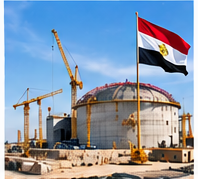
On Egypt’s Mediterranean coast, the El Dabaa construction site illustrates the scale of high-level discussions between Cairo and Moscow. Rosatom is building four 1,200-megawatt nuclear reactors there, with a planned total capacity of 4,800 megawatts. Delivery requires civil engineering works, high-precision equipment, safety rules, operating specialists and maintenance teams. The project also includes training Egyptian personnel who will operate the facility.
The plant offers an industrial possibility worth examining across the continent. African countries’ energy policies have long relied on hydropower, thermal power stations and, more recently, renewable energy. Some states now see civil nuclear power as an additional source of continuous generation, of particular interest to electricity-intensive industrial activities, including metallurgy, chemicals, refineries, cement works and certain digital facilities.
A nuclear power station, however, cannot be built at the same cost or pace as a smaller generating facility. It requires a grid capable of absorbing its output, an independent nuclear safety regulator, long-term financing mechanisms and domestic technical expertise. El Dabaa offers a concrete experience through which interested African countries can assess these requirements.
Local mineral processing at the heart of negotiations
The Democratic Republic of the Congo and Zambia are major copper producers; the DRC leads in cobalt production; Guinea and Ghana have bauxite, while Southern Africa produces manganese, chromium, and platinum-group metals. These resources feed global industries, yet a considerable share of refining, metallurgy and manufacturing takes place outside producing countries. Extraction revenues are no substitute for the jobs and expertise created by a complete industrial value chain.
Projects discussed with Russian companies form part of this pursuit of local processing. In Guinea, Rusal operates the Friguia complex. In Ghana, the joint ventures announced with GIADEC around Nyinahin are intended to combine bauxite extraction with alumina production. The announced capacities—five million tonnes of ore and 1.2 million tonnes of alumina annually—remain targets. Ghana seeks to retain more added value; the Russian industrial group seeks secure volumes and outlets for its operations.
Agriculture and fertilisers: producing on the continent
The availability of agricultural land in several African regions contrasts with persistent food supply challenges. Yields depend on water, seeds, soil fertility, fertilisers and machinery. Harvests then need roads, storage facilities, cold chains and accessible markets. In the DRC, for example, extensive agricultural resources coexist with security, transport and marketing constraints that impede supplies to many communities.
Russia already supplies grain, fertilisers and agricultural equipment. Discussions at the Moscow summit open the prospect of more structured cooperation in local input manufacturing, mechanisation, irrigation and agro-industry. John Dramani Mahama explicitly raised fertiliser production and blending, agricultural machinery, soil mapping and precision farming. Producing fertilisers on the continent requires chemical plants, energy, raw materials, and distribution networks that can reach farmers at affordable prices.
Such a development could reduce certain logistical dependencies and increase production for African markets. It would also require land policies, rural infrastructure and effective access to inputs for farmers.
Satellites, data and scientific training
African delegations also raised space applications as areas of cooperation. Satellite imagery can monitor crop conditions, water resources, land-use changes, and certain climate risks. It also supports geological mapping, infrastructure planning and telecommunications. Ghana raised its use in precision agriculture; Uganda highlighted space technologies and university partnerships.
Having data is not enough to make use of it. Specialists are needed to process it, along with suitable software, laboratories, and institutions that can turn information into services for farmers, local authorities, or businesses. Scientific cooperation can help train such personnel and establish national teams, provided that equipment and working conditions are addressed.
Russia hosts African students and offers training partnerships. Industrial sectors also need nuclear engineers, chemists, metallurgists, mechanical engineers and maintenance technicians.
The conditions for industrial cooperation
Russia and many African countries possess abundant natural resources, but their industrial histories have produced very different capabilities. Moscow has companies active in nuclear power, chemicals, metallurgy, mechanised agriculture and space technologies. African governments seek equipment, financing, productive capacity and skills. They can compare Russian proposals with those of other partners and develop regional projects where national markets are too small to make certain facilities commercially viable. Their negotiating capacity depends on the technical and financial expertise available to them and on having defined their industrial priorities in advance.
The Egyptian nuclear project, Friguia’s operations in Guinea, and the proposed Nyinahin alumina project in Ghana offer different contexts for monitoring this cooperation. Future achievements can be measured by electricity actually supplied, minerals processed locally, fertilisers produced, qualified personnel employed and local companies involved in the facilities. These results will judge decisions taken in Moscow over the coming years.
Documentary references — Russia–Africa Summit
African Union, Agenda 2063 and Russia–African Union Commission cooperation documents (28 October 2026).
Institutional communications from the Egyptian and Ghanaian delegations concerning the El Dabaa, Suez and Nyinahin projects.
Communications from Rosatom, Rusal and GIADEC relating to the industrial projects mentioned.