
Current Affairs & Debate · Merisphere Weekly
Russia–Africa Summit
— In Moscow, African leaders negotiate their industrial future
From the Kremlin to Gostiny Dvor, the meetings of 28 and 29 October brought African development programmes and Russian industrial proposals closer together. Beyond the ceremonies, delegations discussed electricity, fertilisers, minerals, space technologies, training and financing.
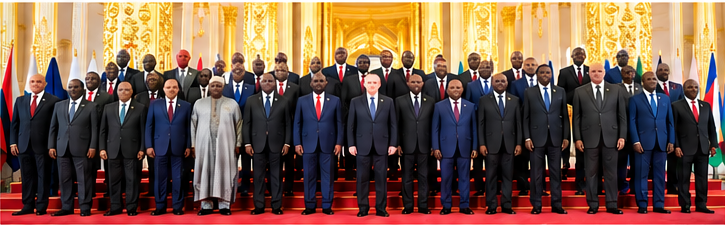
Moscow: two days of African diplomacy
A few hundred metres from Red Square, Gostiny Dvor once again became a meeting place on 28 and 29 October 2026. The Russia–Africa Economic and Humanitarian Forum took place in this former trading hall in the Kitay-Gorod district. Business representatives, sectoral officials and official delegations gathered there to discuss projects whose political direction heads of state and government were negotiating at the Kremlin. The contrast between the reception rooms of Russian power and the old commercial hall captured the meeting’s twin ambitions: to give the relationship diplomatic prominence and to turn it into economic achievements.
Organisers announced the participation of 48 African countries, 22 of them represented by heads of state. Vladimir Putin and Évariste Ndayishimiye, President of Burundi and current Chairperson of the African Union, co-chaired the meeting. Following Sochi in 2019 and St. Petersburg in 2023, Moscow thus hosted the third stage of Russia–Africa summit diplomacy. The official photograph of the delegations at the Kremlin, bilateral audiences and the plenary session on 29 October were its principal rituals. The economic forum, meanwhile, announced dozens of discussions on industry, transport, agriculture, energy, trade and training.
The arrival of Egyptian President Abdel Fattah el-Sisi on 28 October and his talks with Vladimir Putin gave this protocol tangible substance. Cairo and Moscow already had two major dossiers to examine: construction of the El Dabaa nuclear power plant and the proposed Russian industrial zone near the Suez Canal. The following day, the Egyptian President also met Rosatom’s head, Alexey Likhachev. For Egypt, the meeting was not merely a promise of future cooperation; it provided an opportunity to discuss projects already underway and their next stages.
African development programmes reach the Kremlin
The African delegations did not arrive in Moscow without a roadmap. The African Union’s Agenda 2063 had already set out ambitions for industrialisation, resource processing and regional integration. Mahmoud Ali Youssouf, Chairperson of the African Union Commission, situated cooperation with Russia within that framework, emphasising access to capital, the cost of credit, productive capacity and Africa’s place in international institutions.
Ghana seeks fertilisers and an alumina industry
John Dramani Mahama outlined a series of priorities for Ghana that directly link agriculture and industry. Ghana is seeking partnerships in fertiliser production and blending, agricultural machinery, agro-industry, pharmaceuticals, energy, transport and digital technology. The Ghanaian President also raised the need for soil mapping, precision agriculture and the use of satellite data. To sell more African products in Russia, he called for predictable standards, reliable logistics and workable payment arrangements, including in national currencies.
On 29 October, the announcement of two joint ventures between Rusal and GIADEC, concerning Nyinahin bauxite and a future alumina refinery, gave these discussions an industrial dimension. The stated targets are five million tonnes of bauxite and 1.2 million tonnes of alumina a year. Under the announced arrangements, Rusal would hold a majority stake, while Ghana’s 10% holding would be non-dilutable.
Accra’s interest is to increase bauxite processing on Ghanaian soil rather than limit revenues to extracting and exporting ore. Rusal’s is to secure industrial supplies. Both aims can be pursued through a refinery, provided the facilities are built, the necessary energy supplied, staff trained and markets organised. The contract will need to specify how much activity, employment and expertise will remain in Ghana.
Egypt presents cooperation already under way
In his address on 29 October, Abdel Fattah el-Sisi advocated five areas of cooperation: transport corridors and logistics zones; intra-African trade; energy and electricity interconnections; water and food security; and telecommunications and information technologies, including artificial intelligence. He placed these priorities within African states’ capacity to define their own development policies. The Nile, the Red Sea and the situation in Sudan also featured among his regional concerns.
At El Dabaa on the Mediterranean coast, Rosatom is building four nuclear reactors, each with a capacity of 1,200 megawatts. Construction draws on expertise in civil engineering, engineering design, safety, maintenance and operations. It also requires training Egyptian personnel and, in due course, integrating substantial generating capacity into the national grid. Near the Suez Canal, the proposed Russian industrial zone responds to a different ambition: to host productive activities close to shipping routes and markets.
These projects are at different stages. El Dabaa is under construction; the industrial zone must be assessed by the companies that actually establish themselves there and the production they begin. For Egypt, their combination nevertheless offers a strategic prospect: access to electricity, logistics platforms and manufacturing capacity.
From the Sahel to Central Africa: other expectations
Representatives of Mali and Burkina Faso stressed security issues in their discussions with Moscow. Burkina Faso was represented by its Prime Minister, Rimtalba Jean Emmanuel Ouédraogo. Official communications from both countries also highlight discussions on agriculture, mining, energy and transport.
According to reports from its delegation, Uganda highlighted technical training, university partnerships, space technologies, artificial intelligence and climate-adapted farming practices. The Central African Republic emphasised employment and the processing of raw materials. Moroccan proposals reported around the meeting concerned energy, Atlantic corridors and possible access to the sea for Sahelian countries.
Grain, fertilisers, energy and training: Russia’s proposals
Russia has several ways to respond to African countries’ requests. It is a major global supplier of grain and fertilisers, has mining and metallurgical companies, is a leading player in civil nuclear power, and possesses industrial equipment, research capabilities and space technologies that could make a substantial contribution to African development. Decisions taken in Moscow may therefore concern both goods available for immediate delivery and long-term industrial investment.
Civil nuclear power has a particular place in these exchanges. Processing industries require a reliable electricity supply, which grids in many African countries cannot always guarantee. Power-station construction, grid operation, and engineer training are therefore central questions for the partners.
Agreements adopted and their implementation
The meeting concluded with a final declaration and a Russia–Africa Action Plan for 2027–2029. The plan, concluded on 28 October between the African Union Commission and the Russian Federation, covers nineteen areas of cooperation; the African Union specifies that it does not create obligations under international law.
Existing operations already reveal different situations. In Guinea, Rusal has operated the Friguia complex for a long time. In Egypt, El Dabaa is under construction, while the Suez Canal industrial zone remains to be assessed against its actual roll-out. In Ghana, Nyinahin is the subject of joint-venture announcements and production targets. The space, university and energy partnerships discussed in other countries have not all reached the same stage of contractual commitment.
Delegation leaders left Moscow after two days of ceremonies, speeches and meetings. The 2027–2029 plan will serve as a reference for governments and businesses when reporting the financing mobilised, factories built, technicians trained and new output achieved. The first significant results will be seen in Egypt, Guinea and Ghana, where projects already have an identifiable industrial or contractual foundation.
