
South Africa: Has femicide become an ‘epidemic’?
The successive discovery of women’s bodies in Ekurhuleni comes in a country where gender-based violence and femicide are now classified as a national disaster. Investigations have yet to determine whether these cases are connected. Their succession has once again brought to the fore the scale of violence against women in South Africa and the measures being taken to prevent, investigate and punish it.
Nine women’s bodies were discovered within two months in the municipality of Ekurhuleni, east of Johannesburg. The ninth was found on 17 September at Dawn Park. The South African police added it to the investigations already opened into the deaths of women in this part of Gauteng.
The succession of discoveries prompted the hypothesis that several cases might be connected. The circumstances present certain similarities, but the police have not established that one perpetrator, or one group of perpetrators, was responsible. The chair of Parliament’s police committee has himself urged that a connection which the investigation has yet to demonstrate should not be presented as established.
This distinction is necessary. Nine women found dead in the same area within a few weeks is a fact. The existence of a single series of crimes remains an investigative hypothesis.
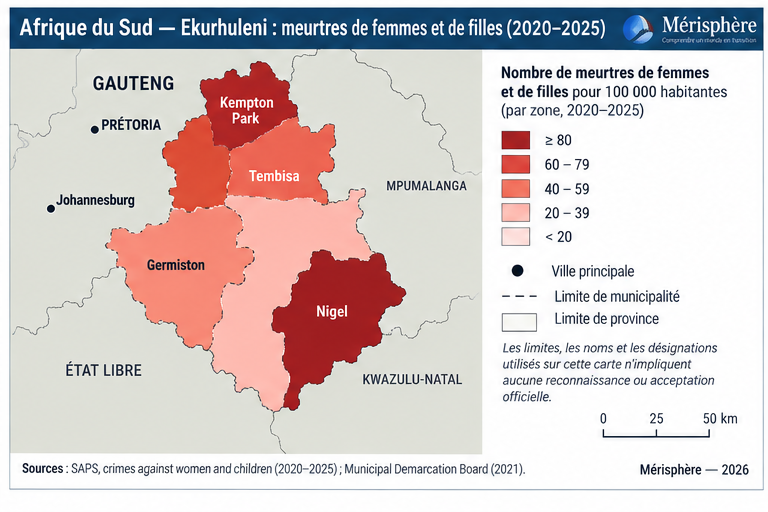
These deaths have occurred in a country that has already recognised gender-based violence and femicide as a problem requiring a national response. In November 2025, the National Disaster Management Centre classified gender-based violence and femicide as a national disaster under the Disaster Management Act.
The issue raised in Ekurhuleni therefore does not concern institutional recognition of the problem. It now concerns the resources that this recognition actually makes it possible to mobilise.
Nine cases, a wider investigation
The South African Police Service has established a multidisciplinary team to deal with the Ekurhuleni cases. It brings together specialist investigators, forensic experts, search and tracking resources and expertise in investigative psychology.
The arrangement first addresses the needs of the criminal investigation: identifying victims who have not yet been identified, determining the causes of death, reconstructing their last movements, examining the scenes where the bodies were found and looking for possible common elements.
Caution about whether the cases are connected does not prevent them from being examined together. It prevents the initial hypothesis from being turned into a conclusion before the material evidence has been analysed.
It also affects the public response. If the crimes are connected, the investigation must identify the perpetrator or perpetrators and stop the series. If they are not, their concentration in one area raises, in another form, the question of women’s safety and the capacity of institutions to prevent and prosecute separate acts of violence.
In both cases, the criminal investigation remains essential. It does not, however, exhaust the question raised by these deaths.
From recognition to resources
On 20 November 2025, President Cyril Ramaphosa described gender-based violence and femicide as a national crisis. The National Disaster Management Centre then classified them as a national disaster under the Disaster Management Act.
This classification establishes national responsibility for coordination. The administrations concerned must report on the action undertaken, and several public arrangements are expected to contribute to the response: policing, justice, health, social services and specialist support structures.
The government has included in this arrangement the interministerial committee on gender-based violence, the ninety-day acceleration programme, the expansion of Thuthuzela centres, the strengthening of specialist sexual-offences courts and certain criminal-justice reforms.
The classification is not, however, equivalent to declaring a national state of disaster. The chosen mechanism allows the government to address the situation through existing legislation and coordination arrangements already in place.
This legal difference brings the discussion back to available resources. Classifying a phenomenon as a national disaster creates duties of coordination, monitoring and reporting. Everyday prevention then depends on staffing, budgets, investigative capacity, the reception of victims, the speed of expert examinations and the operation of the courts.
Preventing, investigating and prosecuting
Policies to combat violence against women cover several stages that do not fall to the same institutions.
Prevention occurs before the crime: information, detection of violent situations, protection of people under threat, handling of complaints and action on the factors that expose certain women to repeated violence.
An investigation begins when an offence has been committed or is suspected. It requires trained police officers, forensic capacity, identification systems and the ability to compare information quickly from several police stations or areas.
Prosecution then belongs to the judicial system. An investigation may identify a suspect without leading to a conviction if the evidence gathered does not establish that person’s responsibility before a court.
The Ekurhuleni murders place these three dimensions in the same current situation. The repeated discovery of bodies leads to a search for those responsible; it also requires examination of how disappearances are reported, information is compared and people at risk are protected.
Criminal responsibility and institutional responsibility
Responsibility for a murder belongs to the person or persons who committed it. It cannot be transferred to an administration solely because a crime occurred within its territory.
The responsibility of institutions is different. It concerns the duties incumbent upon them before and after the offence: receiving complaints, searching for missing persons, protecting those under threat, preserving and analysing evidence, investigating and enabling prosecutions to proceed.
Distinguishing these two forms of responsibility avoids requiring the state to answer in law for acts of which it is not the author. The distinction also makes it possible to assess its action on the basis of what actually falls within its powers.
In Ekurhuleni, that assessment cannot be completed while the investigations are under way. It will be necessary in particular to establish whether earlier information could have allowed some cases to be connected sooner, whether reports had been made and under what conditions the different services exchanged their data.
For now, the police have mobilised a specialist team and brought the nine discoveries within a common investigative arrangement, without concluding that they all form part of the same series of crimes.
A national classification tested by events
The classification of gender-based violence and femicide as a national disaster has given South Africa a strengthened institutional framework. Its effectiveness cannot, however, be assessed from its title.
It depends on the effects produced in police stations, forensic laboratories, courts, social services and protection arrangements.
The Ekurhuleni cases provide a concrete test in this respect. The existence of nine investigations does not yet permit a general assessment of South African policy against violence towards women. It does, however, identify the questions that policy must answer: the speed of investigations, circulation of information, identification of victims, protection of people at risk and the capacity to bring perpetrators before the courts.
National recognition has already occurred. The resources deployed and the results of the investigations will make it possible to measure its effects.
In the Merisphere Documentary Collection
Sources
South African Police Service (SAPS).
Parliament of the Republic of South Africa.
National Disaster Management Centre / Government of South Africa.
South African Medical Research Council (SAMRC).
Human Sciences Research Council (HSRC).