
Sudan — When humanitarian aid chooses its beneficiaries
Nearly 19.5 million Sudanese people are facing acute hunger. The resources available do not allow humanitarian organisations to meet all identified needs. Targeting, designed to direct assistance towards the most vulnerable, has also become a way of managing its scarcity.
Sudan has been at war since April 2023. The conflict between the Sudanese Armed Forces and the Rapid Support Forces has displaced millions of people, disrupted agricultural production, damaged markets and transport networks, and restricted access to many areas of the country.
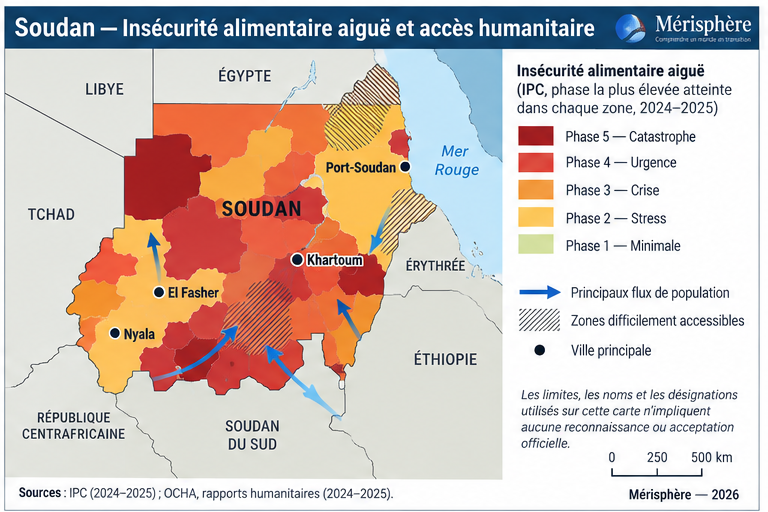
Food insecurity has become one of the principal consequences of the conflict. According to the Integrated Food Security Phase Classification (IPC), nearly 19.5 million people are facing high levels of acute food insecurity. The situation varies considerably between regions. Some areas affected by fighting, displacement and difficulties in gaining humanitarian access face particularly severe conditions.
The scale of the needs does not mean that humanitarian organisations are able to assist everyone affected.
Needs exceeding available resources
Humanitarian assistance depends on several conditions. Organisations must be able to reach the populations concerned, assess their needs, obtain the necessary funding, purchase or transport supplies and organise their distribution.
War affects each stage of this process. Roads may become inaccessible. Front lines change. Administrative restrictions can delay operations. Humanitarian workers and convoys may be exposed to violence. Markets may no longer function normally. Populations themselves move, sometimes repeatedly, making previous assessments rapidly obsolete.
Funding adds another constraint. Humanitarian organisations establish response plans based on the needs they identify. Donors then decide how much they will contribute. The amounts actually received may be substantially lower than those requested.
When this happens, the organisations responsible for distributing assistance have to decide where the available resources will go.
Targeting
Humanitarian targeting is intended to identify the people or areas that should receive priority assistance. Several criteria may be used: severity of food insecurity, malnutrition, displacement, loss of livelihoods, age, household composition, health conditions or exposure to particular risks.
Targeting may be geographical. Assistance is then concentrated on territories where the situation is considered most serious. It may also be based on households or individuals whose circumstances meet predefined vulnerability criteria.
This procedure is necessary whenever needs differ in severity. It becomes more difficult when the total resources available are insufficient.
The distinction matters. A person who does not receive assistance is not necessarily considered to have no need for it. The organisation may simply have placed other people above that person in the order of priority.
The threshold separating beneficiaries from non-beneficiaries may therefore depend not only on need, but also on the quantity of assistance available.
Administering scarcity
A shortage of resources changes the function of targeting. The purpose is no longer solely to identify those most in need. It is also to determine which needs can be met and which cannot be met with the resources available.
This situation can lead organisations to reduce the number of beneficiaries, decrease food rations or cash transfers, space out distributions or suspend certain programmes.
The humanitarian system then faces a difficult allocation problem. Giving more to one group may mean giving less to another. Extending assistance to a larger number of people may require reducing the amount received by each beneficiary. Concentrating resources on the most severely affected areas may leave other vulnerable populations with little or no assistance.
These choices are not equivalent to political decisions about the distribution of public resources within a state. Humanitarian organisations operate under specific mandates and depend largely on voluntary funding. They nevertheless make decisions that have direct consequences for the living conditions of populations.
Access and funding
Two constraints must be distinguished. The first is humanitarian access. Assistance may exist but be impossible to deliver because fighting, blockades, insecurity or administrative restrictions prevent organisations from reaching the people concerned.
The second is funding. Organisations may have physical access to an area but lack the resources required to assist everyone in need.
The two problems can occur simultaneously, but they do not have the same cause and do not require the same response. Improved access does not solve a funding shortfall. Additional funding does not automatically open a road closed by fighting or remove an administrative restriction.
In Sudan, the humanitarian crisis combines both constraints.
The consequences of selection
Targeting is generally presented as a technical instrument. It relies on assessments, indicators and criteria intended to identify vulnerability.
Its effects are nevertheless concrete. It determines who receives food, cash, medical assistance or other forms of support and who must wait or seek other means of survival.
The quality of the information available is therefore decisive. A household classified as less vulnerable on the basis of an earlier assessment may have lost its income in the meantime. A population movement may change the number of people requiring assistance in a particular area. A locality that was accessible when an assessment was conducted may subsequently become isolated.
The more resources fall short of needs, the greater the consequences of these uncertainties.
Sudan illustrates a broader characteristic of humanitarian action. Needs are assessed in relation to the condition of populations, but assistance is distributed within the limits of resources that states and other donors agree to provide.
When those resources are insufficient, humanitarian organisations do not eliminate the unmet need. They decide which part of it they are able to address.
In the Merisphere Documentary Collection
Sources
Integrated Food Security Phase Classification (IPC), Sudan food-security assessments and projections.
United Nations Office for the Coordination of Humanitarian Affairs (OCHA), Sudan humanitarian situation and response data.
World Food Programme (WFP), Sudan emergency and food-security information.