Land is never an abstraction: above all, it is a place of memory
The project does not, however, rest on a cartographic abstraction. One hundred and thirty-three residents have gone to the Kenyan courts asserting rights over land affected by the development. Justice Jane Onyango ordered that the status quo be maintained while the dispute is examined. Nevertheless, the political and industrial launch of the project went ahead.
The litigation recalls a longstanding difficulty surrounding major African projects. The cadastre, registered title, customary use, longstanding occupation and family inheritance do not always coincide. A plot may appear available in an administrative file while having been inhabited, cultivated, used or claimed for several generations.
The court will have to determine the scope of the rights claimed and the obligations of the developers and authorities. The existence of a claim does not prejudge its outcome. It does, however, prevent the site from being presented as a legally neutral space before judgment.
Industrialising without erasing human rights
Major infrastructure projects require land, road access, security zones, port facilities and, at times, the displacement of populations. Property rights and expropriation mechanisms therefore become components of industrial policy.
Local processing of raw materials remains a major objective for many African states. It does not dispense with the land question. Industrialisation pursued against rights recognised by law, or without a credible compensation mechanism, generates its own costs: litigation, delays, local distrust, and political fragility for the project.
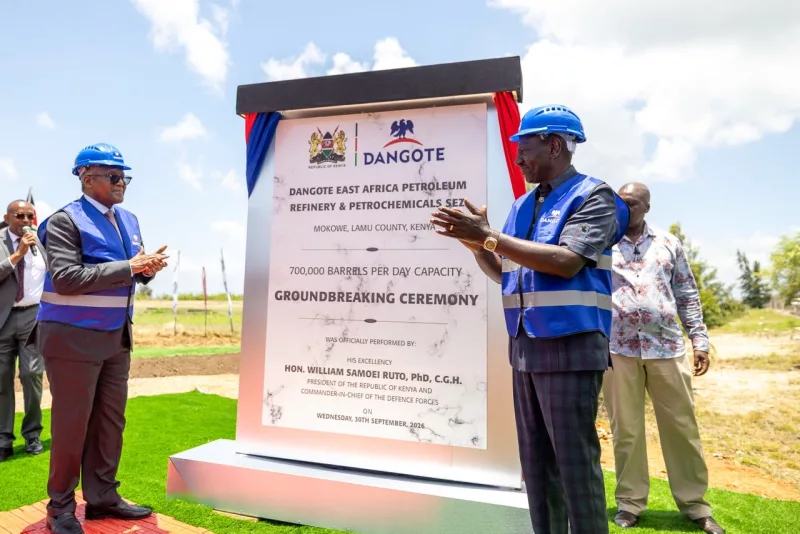
The Lamu case also helps put an often spectacular figure into perspective. The announced nominal capacity is 700,000 barrels a day. It does not mean the installation already exists, will immediately operate at that level, or that actual production will reach that volume every day. Construction, crude supply, infrastructure and the ramp-up phase will determine effective output.
Land is not the only friction point. Lamu Old Town is a UNESCO World Heritage Site, and port development in the region has long been contested over coastal ecosystems, fishing and the livelihoods of local communities. The refinery adds a very large oil installation to these debates. Assessment of the project will therefore have to address land ownership, compensation, environmental effects and the economic benefits actually distributed within the region.
The launch ceremony took place on 30 September in the presence of several African leaders. The land dispute did not disappear with the speeches. The next court hearing is expected to clarify residents’ rights and the conditions under which the project may proceed.