These results do not allow African states to be divided into two camps, one favouring the West and the other aligned with Moscow. Rather, they show that several governments wish to distinguish their assessment of the war, their bilateral relations and their willingness to support particular measures proposed against Russia.
In March 2022, Senegal explicitly invoked the principles of non-alignment and the peaceful settlement of disputes to explain its abstention. South Africa advocated a negotiated solution while maintaining its relations with Moscow. Other governments, without abandoning their Western partnerships, refused to support certain diplomatic sanctions.
These positions fall far short of a common African policy. They do, however, restore urgency to an old question that seemed to have lost its relevance with the disappearance of the Soviet Union.
Non-alignment was never simply a matter of maintaining equal distance from Washington and Moscow. It arose from a more fundamental question: how can a state, particularly one with fewer resources than the great powers, preserve its ability to decide for itself?
That question did not disappear with the Cold War. Only its context changed.
Bandung: When Colonised Peoples Challenged Their Place in the World Order
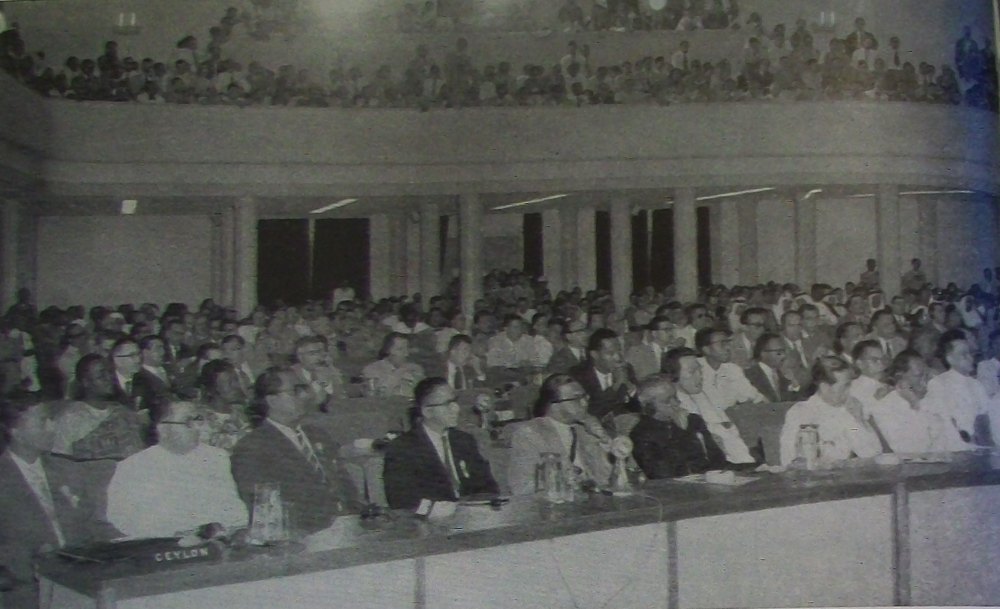
In April 1955, twenty-nine governments from Asia and Africa gathered in Bandung, Indonesia. The conference took place ten years after the founding of the United Nations, in a world already deeply divided.
The United States had built a system of military alliances around itself. The Soviet Union led a group of communist regimes in Eastern Europe. The Korean War had ended two years earlier. France had recently suffered defeat at Dien Bien Phu, while most of Africa had yet to be decolonised.
The contradiction at the heart of the international order was plain. The United Nations Charter affirmed the sovereign equality of states and the right of peoples to self-determination. Yet much of Africa remained deprived of sovereignty, while five powers held veto rights on the Security Council.
Bandung placed this contradiction at the centre of international relations. Participants defended independence, equality, non-interference and the peaceful settlement of disputes. They also sought to develop economic and cultural cooperation.
It would therefore be inaccurate to portray the conference as the birth of a shared ideology or a homogeneous school of thought. It bears repeating that some participants maintained close military relations with the United States; others drew nearer to the Soviet Union or China. Their interests and political systems differed.
What united them, therefore, was not a single doctrine of alliances, but a refusal to accept that the future of Asian and African peoples should be decided in the capitals of the great powers.
The Non-Aligned Movement was formally established six years later, in Belgrade, in September 1961. The distinction matters: Bandung expressed a historical demand; Belgrade sought to give it an organised diplomatic existence.
Between these two events, the Suez Crisis demonstrated that a state could exploit international rivalries to defend a sovereign decision.
Suez, 1956: Non-Alignment Tested by a Sovereign Decision
On 26 July 1956, Gamal Abdel Nasser announced the nationalisation of the Suez Canal Company, controlled chiefly by British and French interests.
The decision followed the withdrawal of American and British offers to finance the Aswan High Dam. Nasser sought funding for a major project involving irrigation, electricity generation and industrial development. In 1955, he had already concluded a significant arms agreement with Czechoslovakia, a member of the Soviet bloc.
Nationalisation triggered an international crisis. On 29 October 1956, Israel attacked Egypt. France and the United Kingdom subsequently intervened militarily under a plan prepared with Israel.
The operation initially achieved military successes but encountered opposition from both the United States and the Soviet Union. Washington exerted considerable financial and diplomatic pressure on London. The intervention had to end, and foreign forces had to withdraw.
Nasser retained control of the canal.
This episode illuminates non-alignment better than many declarations of principle. The Egyptian president had not rejected all cooperation with the great powers. He had sought Western financing, obtained weapons from the Soviet bloc and exploited the contradictions between the United States and its European allies.
His aim was not to remain equally distant from everyone, but to retain the freedom to decide what he considered to be in his country's interest.
The experience also reveals the limits of that freedom. Egypt subsequently developed extensive military and economic cooperation with the Soviet Union. In 1972, Anwar el-Sadat expelled thousands of Soviet military advisers before gradually redirecting Egyptian diplomacy towards the United States.
At different moments, the same country thus sought autonomy by changing its alliances.
This history prevents us from reducing non-alignment to an unchanging list of partners. It raises a more demanding question: does a change of alliance genuinely increase a state's capacity to act?
Nkrumah and Sékou Touré: Political Independence Does Not Resolve Dependence
Ghana became independent in March 1957. Kwame Nkrumah quickly understood that ending colonial administration was not enough to transform the economic relationships linking African territories to European metropolitan powers.
The country mainly exported cocoa and depended on international markets for its revenue. Industrialisation required capital, equipment, technical expertise and infrastructure, much of which had to be obtained abroad.
Nkrumah sought to build a national economy capable of sustaining political independence. The Akosombo Dam, whose construction began in 1961, embodied that ambition. Yet its financing and the development of the aluminium industry also exposed the complexity of relations between the Ghanaian state and foreign economic interests.
In Neo-Colonialism, the Last Stage of Imperialism, published in 1965, Nkrumah framed the problem politically: a state may be legally independent while remaining subject to economic decisions taken beyond its borders.
His answer is well known: building African power requires political and economic integration beyond the borders inherited from colonial rule.
Sékou Touré confronted the issue differently. In September 1958, Guinea rejected the French Community proposed by General de Gaulle and chose immediate independence. The break with Paris brought severe administrative and economic difficulties. Conakry then sought other sources of support, notably from socialist countries.
Independence had been secured; the material means of exercising it still had to be built.
Amílcar Cabral, involved in the struggle for the independence of Guinea-Bissau and Cape Verde, took the argument further. He linked national liberation to the transformation of social relations, culture and the ability of peoples to regain the initiative in shaping their own history.
These trajectories differ profoundly. Yet they converge on one point: diplomatic independence remains fragile when the economic, technical and military means of decision-making lie beyond the control of the new states.
That difficulty would persist for decades.
The Congo, Angola and the Horn of Africa: the historical limits of non-alignment
The Congo’s independence, proclaimed on 30 June 1960, was followed almost immediately by a major crisis.
The mutiny of the Force Publique, Katanga’s secession, foreign interventions and rivalries among Congolese leaders prompted United Nations intervention. Faced with the disintegration of state authority, Patrice Lumumba sought international assistance. His approaches to the Soviet Union helped draw the Congolese crisis into the East–West confrontation.
His assassination in January 1961 became one of the most tragic events of African decolonisation.
The crisis demonstrated how quickly proclaimed sovereignty could be undermined when a state controlled neither its armed forces nor its strategic resources nor its entire territory.
Angola experienced another form of this contradiction after gaining independence in November 1975. Its civil war pitted African movements against one another, each benefiting from competing external support. The Soviet Union and Cuba backed the MPLA; the United States and South Africa supported its opponents at different times.
The Angolan movements pursued objectives of their own. But their confrontation also became an arena of international conflict.
The Ogaden War between Somalia and Ethiopia in 1977–78 likewise revealed how alliances could shift. Siad Barre’s Somalia, previously closely aligned with Moscow, moved towards the United States when the Soviet Union decided to support Mengistu’s Ethiopia.
These episodes require us to distinguish two things. African states are not merely instruments of foreign powers: they have interests, ambitions and conflicts of their own. Yet the military and financial resources available to the great powers enable them to exert considerable influence over events.
Non-alignment thus appears less a position securely attained than a freedom constantly under threat.
It should be noted that this difficulty is not unique to Africa. It belongs to the wider history of international relations: secondary powers continually seek to preserve their autonomy within systems dominated by stronger actors.
What makes the African question distinctive is the combination of recent decolonisation, the continent’s political fragmentation and the economic dependence inherited from colonial rule.
The New International Economic Order: when non-alignment changes its focus
During the 1970s, the demands of countries in the Global South gradually shifted towards the structures of the world economy.
The problem was now framed in terms of commodity prices, control over natural resources, technology transfer, development finance and reform of international economic institutions.
In 1974, the United Nations General Assembly adopted the Declaration on the Establishment of a New International Economic Order.
Developing countries called for a transformation of the rules governing trade and finance. They challenged an international division of labour in which they mainly supplied raw materials while importing higher-value manufactured goods.
The demand extended the aspirations expressed at Bandung, but in a different setting. Most African states had secured political independence; economic inequality remained.
The Organisation of the Petroleum Exporting Countries had shown, through the price rises of 1973, that some producers could alter the terms of negotiation with industrialised countries. But that experience could not simply be replicated for every commodity.
The debt crisis of the 1980s and the structural adjustment programmes imposed on many African countries subsequently narrowed governments’ room for manoeuvre.
International financial institutions became major actors in national economic policy. Budgetary choices, industrial policies and administrative reforms were often negotiated under markedly unequal conditions.
The question of non-alignment was therefore recast: how could economic sovereignty be preserved when a state depended on creditors, donors and external markets?
The answer could no longer be confined to choosing a diplomatic partner. It now concerned the very structure of the national economy.
After 1991: a question thought to have become obsolete
The disappearance of the Soviet Union in December 1991 profoundly transformed international relations.
The United States emerged as the only superpower capable of military intervention worldwide. The market economy and liberal democracy appeared to have become the dominant models.
Francis Fukuyama interpreted this development as the possible culmination of ideological history in his celebrated argument about the end of history.
In my article “What Does Francis Fukuyama’s The End of History Suggest to Me?”, published by Mérisphère, I questioned the claim that one particular political trajectory could constitute the necessary destination of universal history.
The collapse of a system does not mean that the contradictions which helped produce it have disappeared. The victory of one power does not extinguish the interests of other states, any more than it ends their determination to help shape the international order.
Yet during this period, non-alignment appeared to lose some of its immediate relevance. What was the point of refusing to choose between two blocs when one of them had ceased to exist?
The question rested on a confusion. It equated non-alignment with bipolarity, whereas its deeper purpose was the pursuit of freedom to make independent decisions.
The following decades would make that distinction visible once more.
China, Russia and the emerging powers: the return of choice
China’s accession to the World Trade Organisation in 2001 marked a decisive stage in its rise as an economic power. Industrial growth, exports and overseas investment gradually reshaped the geography of international trade.
In Africa, this transformation has taken the form of expanding infrastructure, mining, telecommunications and trade. The Forum on China–Africa Cooperation, established in 2000, provides a regular framework for relations between Beijing and African governments.
At the Beijing summit in September 2024, President Xi Jinping announced support measures worth 360 billion yuan over three years, including loans, aid and investment.
China, however, is not the only actor in this realignment.
After the economic and political difficulties of the 1990s, Russia sought to recover its international influence. It developed military, energy and diplomatic cooperation with several African countries. The Russia–Africa summits in Sochi (2019) and St Petersburg (2023) reflected that ambition.
India has also strengthened its commercial and technological relations with the continent. Türkiye has expanded its activities in construction, transport, defence manufacturing and diplomacy. The Gulf monarchies have invested in ports, energy, agriculture and logistics infrastructure.
Meanwhile, the United States and European countries retain a substantial economic, financial, diplomatic and military presence.
The result, then, is not the replacement of one dominant power by another. African states now have a wider range of partners that can finance infrastructure, equip their armed forces, purchase their resources, or invest in their economies.
In some respects, this recalls the opportunities Nasser exploited during the Cold War. But the nature of today’s interdependence is different.
Competition no longer concerns military alliances and ideological orientations alone. It extends to strategic minerals, digital technologies, telecommunications networks, industrial supply chains, trade corridors and financial standards.
The historical question therefore remains, although the issues at stake have changed.
The Sahel: a diplomatic break that raises the question of autonomy anew
Recent developments in the Sahel give this question a particularly concrete dimension.
In Mali, French forces deployed under Operation Barkhane left the country in August 2022. At the same time, the transitional authorities developed security cooperation with Russia.
In Burkina Faso, French special forces withdrew in 2023 after the agreement governing their presence was terminated.
In Niger, the July 2023 coup was followed by a reorientation of military partnerships. French forces withdrew; in 2024 the United States also evacuated its facilities, including the air base at Agadez.
In September 2023, Mali, Burkina Faso and Niger established the Alliance of Sahel States. It became a confederation in July 2024. Their withdrawal from ECOWAS took effect on 29 January 2025.
These decisions marked a significant break in the history of relations between several Sahelian countries and their Western partners.
They also expressed a determination to establish new regional frameworks for cooperation, particularly in security.
But the historical problem of non-alignment immediately returns: is changing partners enough to secure autonomy?
Egypt’s experience in 1956, Somalia’s in the 1970s and the African conflicts of the Cold War warn against confusing the rupture of an alliance with the end of all dependence.
The question must be judged by results. Do the new partnerships enable the states concerned to exercise greater control over defence, intelligence, personnel training and equipment maintenance? Are their national forces acquiring capabilities they can retain independently of their suppliers?
These questions apply to every form of military cooperation, whatever the partner power.
Genuine strategic autonomy is therefore measured not by the nationality of equipment or instructors, but by a state’s capacity to make decisions, conduct operations and, when necessary, change its alliances.
The Sahel is not a repetition of Bandung. It nevertheless shows why the question Bandung brought to the international stage has acquired fresh urgency.
South Africa, BRICS and the G20: refusing to choose between powers
South Africa illustrates another way of approaching this question.
A member of BRICS since 2010, it maintains important relations with China, Russia, India and Brazil, while continuing to trade extensively with the United States and the European Union.
In February 2023, its navy took part in exercises with the Russian and Chinese navies. The cooperation drew criticism from Western countries, but Pretoria did not abandon its relations with European countries or the United States.
South Africa thus seeks to preserve several diplomatic arenas. Its approach is also shaped by the history of the struggle against apartheid, during which the Soviet Union supported liberation movements, notably the ANC.
The expansion of BRICS in January 2024, with Egypt and Ethiopia joining, increased Africa’s presence in the grouping. But BRICS is not a military alliance comparable to NATO or the former Warsaw Pact.
Its members themselves maintain complex and sometimes competing relationships. India cooperates with the United States while retaining military ties with Russia. China and India have border disputes and strategic rivalries.
For several African states, the attraction of BRICS therefore lies less in joining a bloc opposed to the West than in widening their economic and diplomatic relationships.
The African Union’s admission as a permanent member of the G20 in September 2023 followed a different logic. It enables the continental organisation to participate directly in discussions on debt, development finance, trade and the reform of financial institutions.
In February 2024, the African Union established arrangements for its participation, calling in particular for coordination of African positions and work on reforming the international financial architecture.
Africa has thus gained stronger representation in certain international forums. But securing a seat and influencing decisions are two different things.
Here non-alignment takes a new form: can African states use their presence in several organisations to reshape international rules, rather than merely choose between institutions dominated by others?
Strategic minerals: a new geography of power relations
International competition for African resources offers another illustration of this question's renewed relevance.
The Democratic Republic of the Congo holds a major position in global cobalt and copper production. Guinea has substantial bauxite reserves. Zambia is a major copper producer. Southern Africa possesses resources essential to the supply of platinum, chromium and manganese.
These minerals are used to manufacture batteries, electrical equipment, vehicles, industrial technologies and defence equipment.
The major powers are therefore seeking to secure their supplies and the infrastructure needed to transport them.
The Lobito Corridor, designed to connect the mining regions of the DRC and Zambia to the Angolan port of Lobito, illustrates this competition. The project is supported notably by the United States and European partners.
Yet African states’ interests cannot be reduced to exporting their minerals more quickly.
The continent’s economic history shows that control over natural resources does not guarantee control over the industrial activities that give them value. Producing countries may remain dependent on foreign companies for refining, technology, equipment and access to markets.
The question raised by advocates of a new international economic order in the 1970s thus returns in another form.
It is no longer simply a matter of securing better prices for raw materials. It is a matter of negotiating local processing, skills development, technology transfer, industrial investment and the participation of African companies in production chains.
Diversifying partners can improve negotiating terms. It cannot replace an industrial policy.
This is why the African Continental Free Trade Area is strategically important. By helping to establish larger regional markets, it can support industrial activities that individual national markets cannot always sustain.
The question Nkrumah posed in the wake of independence therefore retains its immediate force: how can economically fragmented states acquire bargaining power when dealing with partners that command vast markets, capital and technology?
Is non-alignment really returning?
The history of international relations now allows us to give a more precise answer.
The non-alignment of Bandung and Belgrade emerged in a world dominated by two antagonistic superpowers. It reflected the determination of decolonised peoples to preserve their independence and take part in shaping the international order.
That determination never disappeared. It found expression in the nationalisation of the Suez Canal, projects for African unity, demands for a new international economic order and attempts to reform international institutions.
But changing circumstances have continually altered the responses available.
During the Cold War, the principal concern was to avoid becoming the satellite of either bloc. After independence, states had to confront the economic dependencies inherited from colonialism. In the 1980s, debt and structural adjustment programmes raised the question of how much freedom remained in economic decision-making. After 1991, American predominance seemed to make the problem of competing alliances less pressing.
Today, China’s rise, Russia’s renewed presence in several regions, the growing influence of middle powers and competition for strategic resources once again confront African governments with choices that recall, without replicating, those of the first decades of independence.
Votes on Ukraine, military realignments in the Sahel, the expansion of BRICS and the African Union’s presence in the G20 all bear witness to this change.
It would nevertheless be premature to see in these developments the rebirth of a united African movement organised around a common doctrine. The continent’s states do not share identical interests, alliances or negotiating capacities.
Some seek privileged cooperation with Russia; others deepen their relations with the United States, Europe or China. Many pursue several partnerships at once.
This diversity does not make the question of non-alignment irrelevant. On the contrary, it reveals the contemporary difficulty. Non-alignment can no longer be understood simply as remaining outside a bloc. It must be judged by states’ ability to set their priorities, negotiate their commitments and reject those that would compromise their essential interests.
A government may multiply its partners and remain dependent. It may also maintain a close relationship with a major power without surrendering control over all its decisions.
The real issue, then, is less the distance a state professes to keep from the great powers than the practical means of its autonomy.
An old question, a new necessity
Perhaps no question in international politics is ever definitively old. Some questions receive provisional answers from history and return when the conditions under which they were answered change. Non-alignment belongs to this category.
At Bandung, it expressed the refusal of colonised peoples to have their fate decided without them. At Suez, it took the form of a sovereign decision defended against military intervention. For Nkrumah, it became a demand for economic strength and African unity. In the 1970s, it inspired the call for a new international economic order.
Today, it has returned to the heart of African diplomacy because power relations are being reshaped and governments have a wider range of choices.
But historical experience warns against mistaking those opportunities for autonomy already achieved.
Competition among partners can enable governments to negotiate more favourable financing, equipment, markets and investment. It can also multiply contradictory commitments and create new dependencies.
Africa will not become a centre of power merely because Washington, Beijing, Moscow, New Delhi, Ankara or the Gulf capitals seek access to its markets and resources.
It will have to convert that competition into lasting capabilities: infrastructure under its control, processing industries, scientific and technical expertise, financial resources, institutions able to negotiate and effective cooperation among its states.
Ultimately, the history of non-alignment teaches us that sovereignty is not simply the freedom to say no. It also requires the means to carry decisions through.
Yes, non-alignment is on the verge of becoming a central question of African diplomacy once again. Not because the Cold War has returned, but because African states, in a profoundly transformed international system, again face the necessity of choosing without submitting.
What is returning is not a doctrine but an unresolved historical question: how can political independence become a genuine capacity to decide one’s own future?
And once again, the answer will depend not only on the skill of African diplomats, but above all on the economic and cultural strength brought to bear in pursuing that project.
Further reading
Antoine Nguidjol, “Ce que me suggère La Fin de l’histoire ? de Francis Fukuyama”, Mérisphère, 2024.
Documentary references for the article’s notes
US Department of State, Office of the Historian, “Bandung Conference (Asian-African Conference), 1955”.
Non-Aligned Movement, “History”, Bandung Conference and Belgrade Summit.
United Nations General Assembly, Resolution ES-11/1, 2 March 2022; comparative analysis of African voting on resolutions concerning Ukraine.
Kwame Nkrumah, Neo-Colonialism: The Last Stage of Imperialism, 1965.
United Nations, Resolution 3201 (S-VI), Declaration on the Establishment of a New International Economic Order, 1974.
African Union, Decision EX.CL/Dec.1255(XLIV), February 2024, arrangements for participation in the G20.
Christopher J. Lee, “The Bandung Conference”, in The Oxford Handbook of History and International Relations, 2023.