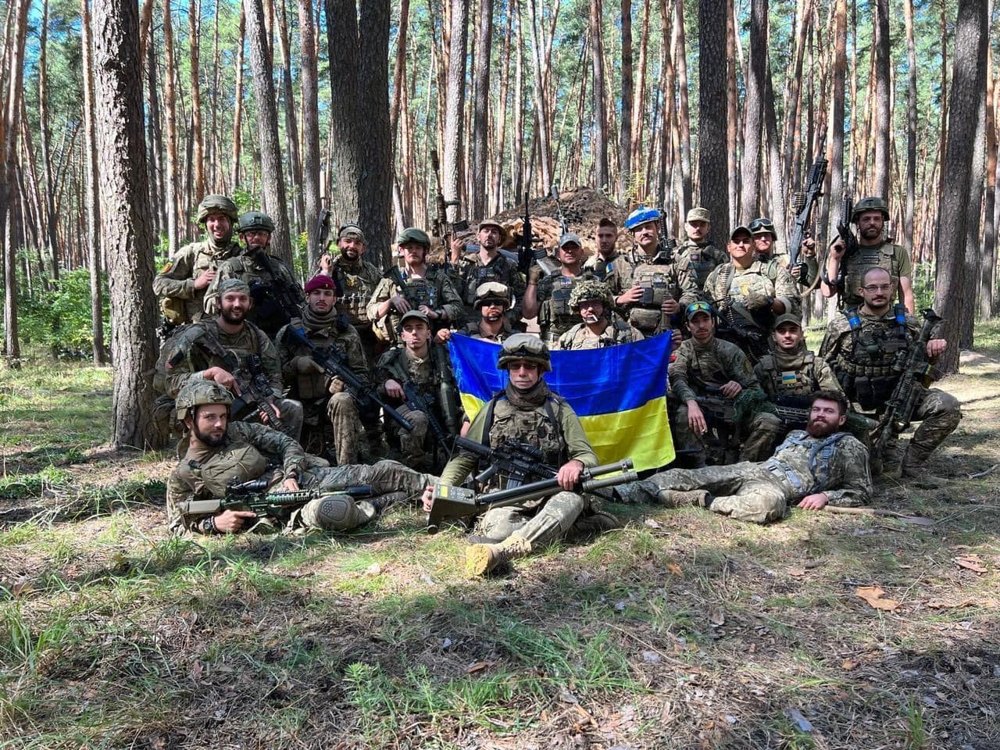
In August 2026, Ukraine’s military ombudswoman, Olha Reshetylova, said that approximately 16,000 foreign volunteers from at least 72 countries were serving in the Ukrainian defence forces. Nearly 40% came from Latin America — around 6,400 people if that proportion is applied to the announced total.
On the Russian side, Ukrainian authorities said that, as at 1 October 2026, they had identified 45,959 foreigners who had signed contracts with the Russian armed forces since the invasion began. They reportedly came from 151 countries and territories. Of these, 16,168 reportedly signed contracts during the first nine months of 2026.
These two figures measure different things. The roughly 16,000 foreigners reported by Kyiv represent an estimate of personnel serving at a particular date. The 45,959 contracts attributed to Russia are a cumulative count of identified enlistments since 2022, potentially including soldiers who have died, been wounded, been demobilised or remain in service. Moreover, the latter figure comes from the opposing side and has not been independently verified.
Even so, the comparison establishes one point: both armies have organised the incorporation of foreign nationals on a scale far beyond isolated individual enlistments.
From foreign legions to contemporary wars: a long history
The use of foreign fighters was not invented by the Russo-Ukrainian war. European monarchies long employed regiments made up of soldiers from other territories. Early modern armies recruited Swiss, German, Scottish and Irish soldiers, sometimes through contracts concluded with princes or military entrepreneurs.
In 1831, France established the Foreign Legion, a military institution designed to incorporate foreign nationals under French command. Its existence reminds us that a foreign soldier serving in a regular army is not automatically a mercenary.
Another precedent sheds light on the Ukrainian conflict: the International Brigades formed during the Spanish Civil War of 1936–39. Tens of thousands of foreign volunteers fought alongside the Spanish Republic, often for ideological reasons. Franco’s side also benefited from foreign fighters and units, notably from Nazi Germany and Fascist Italy, though within different military and political frameworks.
International enlistment may therefore arise from convictions, alliances between states or material incentives. These motives can overlap, but they should not be confused.
After African independence, mercenarism played a particular role in certain conflicts. In the Congo during the 1960s, foreign fighters intervened in secessionist wars and power struggles. In Angola during the 1970s, several European mercenaries were recruited during the civil war.
At the end of the twentieth century, private military companies introduced new forms of organisation. Executive Outcomes, a South African company, operated notably in Angola and Sierra Leone. Later, private security firms were engaged in Iraq and Afghanistan. Russia, in turn, developed networks of contract fighters, with the Wagner Group as the best-known example.
History therefore shows that a market for military skills long predates the war in Ukraine.
What deserves attention today is the geographical reach of recruitment, the coexistence of public and private channels, and the spread of experience gained in a war characterised by intensive use of drones, artillery and electronic warfare.
Ukraine: from an appeal for volunteers to organised military recruitment
At the start of the war in 2022, the Ukrainian authorities appealed for international assistance. The International Legion of Territorial Defence was intended to enable foreigners to take part in resistance to the Russian army.
The first applicants included former Western servicemen, nationals of neighbouring countries and volunteers driven by various political or personal motives.
But initial intentions did not always result in enlistment. Some applicants abandoned their plans to travel; others failed to meet selection criteria or left Ukraine soon afterwards.
As the war continued, Kyiv developed a more structured recruitment system. Foreign nationals could sign military service contracts and join different units of the armed forces.
In August 2025, a Ukrainian official responsible for coordinating foreign enlistment reported that more than 8,000 foreigners had joined the ground forces. Recruitment reportedly rose from about 100–150 people a month at the start of the invasion to around 600 a month.
In February 2026, Kostiantyn Milevskyi, who headed the coordination arrangements, said that nationals of 75 countries were serving in the ground forces and that the cumulative number of contracts signed in those units exceeded 10,000.
The August 2026 announcement that approximately 16,000 foreigners were serving across the defence forces confirmed the importance this component had acquired.
These figures show that foreign recruitment is no longer solely an expression of international solidarity. It also meets a lasting military need in a war involving huge numbers of personnel and heavy losses.
They do not, however, establish that all foreigners enlist for the same reasons. Some act out of conviction; others seek income, professional experience or the possibility of residence.
Incorporation into Ukraine’s regular forces gives them a different status from fighters operating for a private military company outside the chain of command.
Colombia: experience of war as an exportable skill
For decades, the conflict between the Colombian state, guerrillas, paramilitary groups and other armed organisations led the country to train large numbers of experienced soldiers. The 2016 peace agreement with FARC did not end all violence, but it marked a major transformation of the conflict. Meanwhile, soldiers leave the regular forces every year, particularly at the end of their careers. Some veterans possess skills sought after in contemporary wars: weapons handling, reconnaissance, command of small units, operations in difficult terrain and military discipline.
Former Colombian soldiers have already worked abroad, notably in private security arrangements in the Middle East. The phenomenon did not begin in Ukraine.
The war launched in February 2022 nevertheless opened a new destination. According to estimates reported by El País in December 2025, between 2,000 and 3,000 Colombians may have joined Ukrainian forces. Colombia’s Foreign Ministry had by then recorded at least 300 deaths among its nationals involved in the conflict. These figures do not amount to an exhaustive register of enlistments or deaths.
The Colombian case shows how recruitment has acquired a very tangible economic dimension. For some veterans, a contract abroad offers the prospect of earning more than they could at home.
But the human cost is considerable. Colombian families have described difficulties obtaining news of missing relatives, recovering the bodies of fallen soldiers and securing the financial entitlements they believed were due.
Problems involving pay, medical care and protection of families are not, moreover, confined to Colombians.
In August 2026, Ukraine’s military ombudswoman said that her office, established in January, had received more than 300 complaints involving foreign service personnel or their relatives. They concerned, among other matters, payments, healthcare and recognition of service-related rights.
These details give precise meaning to the idea of an international military market: skills acquired in one country’s conflict become usable in a foreign war through contracts whose terms may be disputed.
Russia: foreign recruitment rising sharply
On the Russian side, the available figures indicate a rapid increase in foreign enlistments. According to data released on 20 October 2026 by the Ukrainian headquarters responsible for prisoners of war, Russian military contracts attributed to foreign nationals were distributed as follows:
| Period | Foreign contracts identified |
|---|
| 2022 | 94 |
| 2023 | 4,067 |
| 2024 | 8,877 |
| 2025 | 16,085 |
| January–September 2026 | 16,168 |
Ukrainian authorities announced a total of 45,959 contracts since 2022. The five annual figures reproduced above, however, add up to 45,291 contracts; the 668-contract discrepancy is not explained by the cited data. These figures come from Ukrainian authorities and have not undergone comprehensive independent verification. They are not a count of foreign soldiers currently at the front.
Their chief significance lies in the annual increase they describe. Foreign recruitment, marginal in the earliest 2022 figures, appears to have become an established recruitment channel.
Central Asian nationals account for an important share of these personnel. But reported recruitment also extends to Africa and Latin America.
For the first nine months of 2026, Ukrainian authorities reported 1,449 contracts attributed to Colombians, 699 to Burundians, 530 to Zimbabweans and 503 to Peruvians.
Journalistic investigations published in October and November 2026 refer to approximately 5,400 nationals of 43 African countries identified among Russian recruits since 2022, or nearly 12% of the announced total.
Investigations describe several recruitment methods: social-media advertisements, promises of employment, prospects of high pay, opportunities to obtain Russian citizenship and approaches by intermediaries.
Some individuals may have knowingly signed military contracts of their own free will. Others say they were deceived about the nature of the work, their posting or the conditions for terminating their contract.
Russia rejects allegations of widespread unlawful recruitment and maintains that foreigners can legally enlist in its armed forces. Consent must therefore be assessed through contracts, testimony and actual recruitment conditions, not inferred solely from soldiers’ nationality.
The sums advertised are also under scrutiny. Some recruitment advertisements reportedly offered enlistment bonuses of up to 3.1 million roubles and monthly pay of 260,000 roubles. These offers do not establish that every recruit actually received the amounts promised. They nevertheless demonstrate the importance of financial incentives in certain recruitment campaigns.
The comparison with Ukraine thus reveals a shared reality: both sides incorporate foreigners into their armed forces. It also highlights differences in recruitment, data transparency, and contractual status, as well as allegations of deception that require separate investigation.
Western recruitment channels: what the figures actually tell us
In March 2022, Kyiv announced nearly 20,000 foreign applications from 52 countries. In August 2025, Ukrainian military officials referred to more than 8,000 foreigners who had joined the ground forces. In February 2026, they spoke of more than 10,000 cumulative contracts in those forces. Finally, in August, Ukraine’s military ombudswoman announced approximately 16,000 foreigners serving across the defence forces.
One point remains insufficiently clear: the available public data do not provide a complete, consistent breakdown of fighters in Ukrainian service by nationality, country of residence and previous status. It is therefore impossible to give an exact, reliable total for French, British, American, Canadian or other Western nationals serving in Ukrainian forces. This gap must not be used to erase their presence. It should be stated explicitly, to avoid comparing detailed figures on Russian recruits with a poorly defined Western category.
It also raises a political question: what responsibilities do countries of origin assume when their nationals join a foreign war, even without an official mandate from their government?
Drones and criminal organisations: the risk of returning expertise is already documented
One of the most troubling consequences of these enlistments is now emerging in Latin America. The war in Ukraine has accelerated the use of reconnaissance and attack drones, jamming systems, tactical communications and new methods of coordination between fighting units.
These skills interest criminal organisations seeking to strengthen their capabilities against security forces.
In July 2025, Defence News reported that Ukrainian services were investigating attempts by people affiliated with Latin American cartels to infiltrate the International Legion in order to learn how to operate drones.
In August 2026, the Financial Times published an investigation into efforts by Colombian criminal groups to send recruits to Ukraine to learn drone-warfare techniques. Ukrainian officials said they had identified some applicants linked to organised crime and excluded them from recruitment.
The Colombian situation gives this concern a measurable dimension. According to Colombian Defence Ministry figures cited in the press in August 2026, drone attacks attributed to illegal armed groups reportedly rose from none in 2023 to 333 in 2025. This does not mean that all these attacks resulted from training received in Ukraine. It does show that these techniques are spreading in a setting where criminal organisations already use them.
In September 2026, The Washington Post reported, on the basis of interviews with American and Mexican officials, that criminal organisations were seeking to recruit people returning from the Ukrainian conflict and to send their own members to acquire military experience. One American official said information brought back by Colombian fighters who had served on both sides had benefited drug-trafficking organisations, directly or indirectly.
These investigations do not justify blanket suspicion of veterans. They do, however, document that the risk of skills transfer is no longer merely theoretical.
Mercenaries, volunteers and contract soldiers: what the law says
The vocabulary of public debate often creates confusion. Article 47 of Additional Protocol I to the Geneva Conventions, adopted in 1977, defines a mercenary through six cumulative conditions. They include recruitment specifically to fight, direct participation in hostilities, essentially financial motivation, remuneration substantially greater than that of comparable soldiers, and non-membership of the armed forces of a party to the conflict.
The definition is therefore restrictive. A foreign national incorporated into a regular army does not automatically become a mercenary simply because they receive a salary.
The 1989 International Convention against the Recruitment, Use, Financing and Training of Mercenaries imposes other obligations on States Parties. But existing legal instruments do not cover every contemporary form of international military recruitment in the same way.
It is therefore necessary to distinguish mercenarism in its legal sense from voluntary service in a foreign army, contractual recruitment, deception, and the activities of private military companies.
For an international market in military skills does not depend exclusively on how many people can legally be classified as mercenaries.
It is also evident in the movement of experienced soldiers, contracts, recruiters, pay and military techniques between regions of the world.
A war that may outlive its own ending
The history of international conflicts shows that networks formed during wars do not necessarily disappear when peace agreements are signed.
After the wars of decolonisation, some former combatants joined other conflicts. Private military companies subsequently helped organise the international movement of military expertise. The wars in Iraq and Afghanistan also created lasting networks of specialised personnel, companies and subcontractors.
The war in Ukraine could extend this development on a new scale. Available figures show substantial foreign mobilisation on both sides. Investigations into African and Latin American recruits reveal economic motives, disputed contracts and, in some cases, allegations of deception. Investigations in Colombia and Mexico already document criminal organisations’ interest in skills acquired on Ukrainian battlefields.
States must also monitor returning fighters, recruitment networks and the potential uses of their experience.
Countries of origin will need to distinguish veterans who served lawfully from those who participate in criminal networks. States incorporating foreigners will have to answer for conditions of enlistment, pay, healthcare, demobilisation and protection of families.
As for governments providing military support to either side, responsibility cannot automatically be inferred from individual enlistments. It must be examined in the light of their decisions, oversight mechanisms and the information available to them.
The war in Ukraine did not invent the international trade in military expertise. It has nevertheless given it a new dimension: fighters recruited across several continents are gaining particularly sought-after combat experience, while intermediaries and criminal organisations are already seeking to exploit some of those skills.
Documentary references
Hromadske, “Nearly 46,000 foreigners from 151 countries signed contracts with Russian military, Ukraine says”, 20 October 2026.
Coordination Headquarters for the Treatment of Prisoners of War, October 2026 Monthly Report, Ukraine.
UNN, “Ukraine is defended by about 16,000 foreign volunteers from 72 countries”, 6 August 2026.
Hromadske, “From job offers to the front line: How Russia recruits foreigners to fight in Ukraine”, 29 October 2026.
El País, investigation into Colombian fighters serving in Ukraine, December 2025.
Defence News, investigation into attempts by Latin American criminal organisations to infiltrate the International Legion, July 2025.
Financial Times, investigation into Colombian cartels and drone-warfare training in Ukraine, August 2026.
The Washington Post, investigation into transfers of military expertise to Latin American cartels, September 2026.
International Committee of the Red Cross, Additional Protocol I to the Geneva Conventions, 1977, Article 47.
United Nations, International Convention against the Recruitment, Use, Financing and Training of Mercenaries, 1989.