Sahel — Sovereignty policies confronted with the constraints of regional geography
The temporary reduction in fuel deliveries from BOST Energies to Mali and Burkina Faso highlights the constraint imposed by access to the sea. Being landlocked requires Sahelian states to pursue sovereignty while relying on infrastructure and territories belonging to their neighbours.
In recent months, Burkina Faso and Mali have received less fuel from BOST Energies than they requested. For July and August, Burkina Faso had requested 80,000 tonnes and received 40,000. Mali had received 10,000 tonnes and requested a further 40,000 tonnes for August and September.
An initial Reuters report linked this reduction to increased Ghanaian demand and international tensions in oil markets. BOST Energies issued a clarification on 18 September. The Ghanaian state-owned company stated that the reduction in export volumes was mainly due to rehabilitation work at its Bolgatanga depot in northern Ghana. It ruled out any decision motivated by political, diplomatic or security considerations.
The clarification matters. It brings the event back to what appears to be an ordinary logistical issue. Yet the fact that work on a depot located in Ghana can reduce the quantities available in Mali and Burkina Faso gives a precise measure of the constraints imposed by geography.
Access to the sea
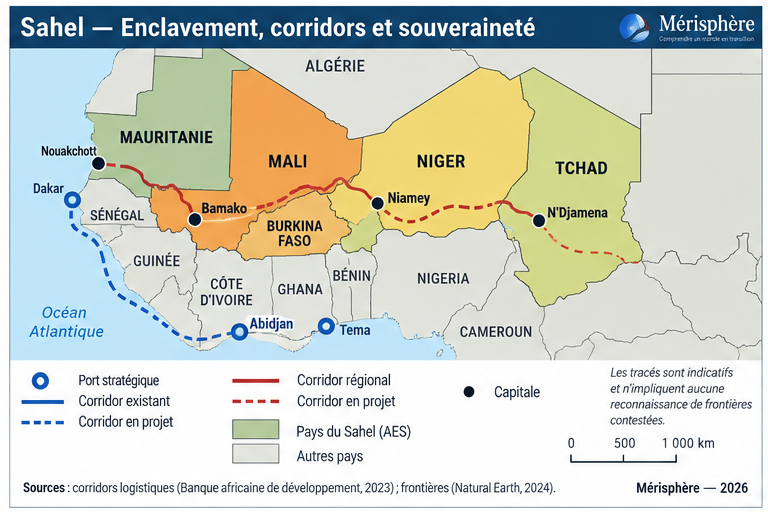
Mali, Burkina Faso and Niger have no access to the sea. Goods imported by sea must pass through the territory of other states.
This constraint is particularly significant for hydrocarbons. Fuel is essential to the transport of people and goods, part of electricity generation, mechanised agriculture, construction, certain public services and military operations. A prolonged disruption to its supply affects many sectors of the economy.
The coastal countries of West Africa are therefore more than transit points. Ports, depots, roads, pipelines, customs procedures and distribution companies form an infrastructure on which landlocked countries depend for access to the global market.
The case of Bolgatanga illustrates the extent of this dependence. BOST Energies normally uses a network combining pipelines and barges to transport petroleum products from southern to northern Ghana. The Bolgatanga depot then supplies part of the Sahelian market. Its rehabilitation is temporarily requiring the company to rely more heavily on road transport from Tema.
The absence of a coastline does not, therefore, fully define landlockedness. It places part of a country's external trade in dependence on infrastructure, logistical capacity and decisions located beyond its national territory.
Building sovereignty through complementary economies
The issue has acquired particular importance since the creation of the Alliance of Sahel States.
Mali, Burkina Faso and Niger have placed sovereignty at the centre of their political discourse. They have left the Economic Community of West African States, reorganised several of their military and diplomatic partnerships and begun building common institutions within the Confederation of Sahel States.
These decisions belong to the political sphere: choosing alliances, joining or leaving an international organisation, entering into or terminating certain agreements.
Supply constraints belong to a different sphere. A government can redirect its foreign policy; goods continue to pass through ports, roads and facilities that are not necessarily located within its territory.
It does not follow that every form of economic dependence constitutes political subordination. Contemporary economies are based on exchange and interdependence. The difficulty arises when the concentration of supply routes severely reduces the alternatives available in a crisis.
Strategic autonomy can be understood through this distinction. It implies neither autarky nor the elimination of all external dependence. It refers to the capacity to retain sufficient alternatives so that dependence on a particular route, supplier or facility does not deprive the state of its room for manoeuvre.
The political changes that have taken place in the Sahel have not eliminated the economic complementarities developed with the countries of the Gulf of Guinea.
Ghana, Côte d’Ivoire, Togo and Benin possess maritime infrastructure that Sahelian countries need. In return, the coastal economies find in the Sahel markets for their ports, transport companies, logistics services and goods.
This interdependence becomes vulnerable when few routes are available or when a substantial share of supply depends on a small number of facilities. A border closure, deteriorating security conditions, a breakdown or, as in Bolgatanga, the rehabilitation of a depot can then disrupt flows.
Diversifying corridors is one response to this vulnerability. It requires several usable ports of entry, sufficiently reliable road or rail routes, storage capacity and commercial relationships with several suppliers.
These solutions nevertheless come at a cost. Stocks tie up financial resources. Infrastructure requires substantial investment. Long-distance road transport can be more expensive than using an integrated network of pipelines and depots. Nor does increasing the number of suppliers guarantee identical commercial terms.
Geography in political choices
BOST Energies states that full export capacity will be restored once the work at Bolgatanga has been completed. The current disruption is therefore presented as temporary. At this stage, there is no basis for attributing political significance to it.
The episode nevertheless provides a useful indication of the position of Sahelian states. Sovereignty asserted through institutions and diplomatic relations must coexist with a geography that places part of their trade within regional networks beyond their national borders.
This reality does not preclude a policy of autonomy. It determines some of the means required to pursue one: multiple corridors, storage capacity, reliable infrastructure and sufficiently diversified agreements to ensure that a problem affecting one route does not become a national supply problem.
For Mali, Burkina Faso and Niger, relations with coastal states therefore remain a component of their sovereignty policies.
In the Merisphere Documentary Collection
Sources
BOST Energies, statement of 18 September 2026 concerning the reduction in export volumes to Burkina Faso and Mali.
Reuters, reporting on BOST Energies fuel exports to Burkina Faso and Mali, September 2026.