
Home › African Current Affairs & Politics › AFRICAN CURRENT AFFAIRS
AFRICAN CURRENT AFFAIRS
South Africa — Automotive industry faces the electric transition in its export markets
SOUTH AFRICA EXPORTED 414,271 LIGHT VEHICLES IN 2025. MORE THAN 70% OF ITS LIGHT-VEHICLE PRODUCTION IS EXPORTED, AND FOUR OUT OF FIVE EXPORTED VEHICLES ARE DESTINED FOR THE EUROPEAN UNION AND THE UNITED KINGDOM. THE ELECTRIC TRANSITION IN THOSE MARKETS IS FORCING SOUTH AFRICAN INDUSTRY TO ACCELERATE ITS OWN TRANSFORMATION.
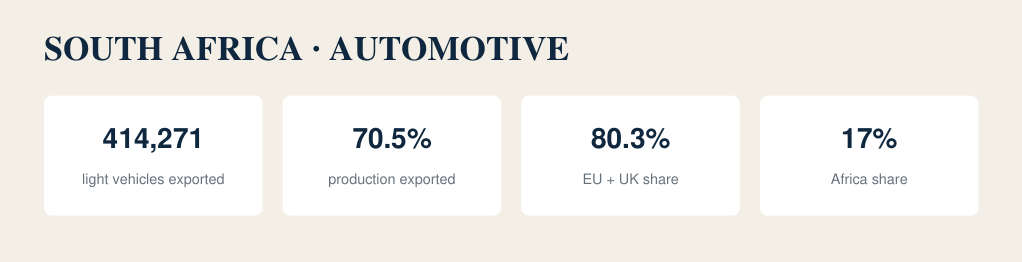
Seven out of ten light vehicles are exported
Naamsa puts the value of vehicle and component exports in 2025 at R291 billion, equivalent to 15.6% of South Africa’s total exports. Trade agreements with the European Union and the United Kingdom have supported this outward orientation. They also expose local plants to changes in standards and powertrain technology decided in those markets.
European markets accelerate the shift to electric vehicles
Pretoria already has instruments to support automotive investment. The Automotive Investment Scheme provides, among other measures, a 20% grant for certain qualifying productive investments by vehicle manufacturers and 25% for eligible component manufacturers and tooling companies. The government is also working to adapt its support arrangements to new-energy vehicles.
Africa still accounts for only 17% of automotive exports
Africa represents 17% of the value of South African automotive exports, with SADC absorbing most of that share. The African Continental Free Trade Area could broaden these markets if rules of origin, infrastructure and finance allow vehicles and components to circulate effectively across the continent. The future of electric mobility in Africa nevertheless extends well beyond South Africa. It concerns fuel imports, electricity generation, battery minerals and the location of value added. Mérisphère will examine these questions in a separate dossier.
AFRICAN CURRENT AFFAIRS
South Africa — Automotive industry faces the electric transition in its export markets
SOUTH AFRICA EXPORTED 414,271 LIGHT VEHICLES IN 2025. MORE THAN 70% OF ITS LIGHT-VEHICLE PRODUCTION IS EXPORTED, AND FOUR OUT OF FIVE EXPORTED VEHICLES ARE DESTINED FOR THE EUROPEAN UNION AND THE UNITED KINGDOM. THE ELECTRIC TRANSITION IN THOSE MARKETS IS FORCING SOUTH AFRICAN INDUSTRY TO ACCELERATE ITS OWN TRANSFORMATION.
Seven out of ten light vehicles are exported
Naamsa puts the value of vehicle and component exports in 2025 at R291 billion, equivalent to 15.6% of South Africa’s total exports. Trade agreements with the European Union and the United Kingdom have supported this outward orientation. They also expose local plants to changes in standards and powertrain technology decided in those markets.
European markets accelerate the shift to electric vehicles
Pretoria already has instruments to support automotive investment. The Automotive Investment Scheme provides, among other measures, a 20% grant for certain qualifying productive investments by vehicle manufacturers and 25% for eligible component manufacturers and tooling companies. The government is also working to adapt its support arrangements to new-energy vehicles.
Africa still accounts for only 17% of automotive exports
Africa represents 17% of the value of South African automotive exports, with SADC absorbing most of that share. The African Continental Free Trade Area could broaden these markets if rules of origin, infrastructure and finance allow vehicles and components to circulate effectively across the continent. The future of electric mobility in Africa nevertheless extends well beyond South Africa. It concerns fuel imports, electricity generation, battery minerals and the location of value added. Mérisphère will examine these questions in a separate dossier.
Verification: Naamsa Automotive Trade Manual 2026; Department of Trade, Industry and Competition, Automotive Investment Scheme.