FRENLN
HOME › AFRICAN CURRENT AFFAIRS & POLITICS › WEST AFRICA › SENEGAL
WEST AFRICA / SENEGAL

Senegal — Diomaye Faye and Sonko: power before friendship?

Bassirou Diomaye Faye and Ousmane Sonko no longer govern together. The Senegalese president has now said publicly what had been increasingly clear for months: the political break between the two men is complete.
Koffi Mensah
25 September 2026 | Reading time: 8 minutes
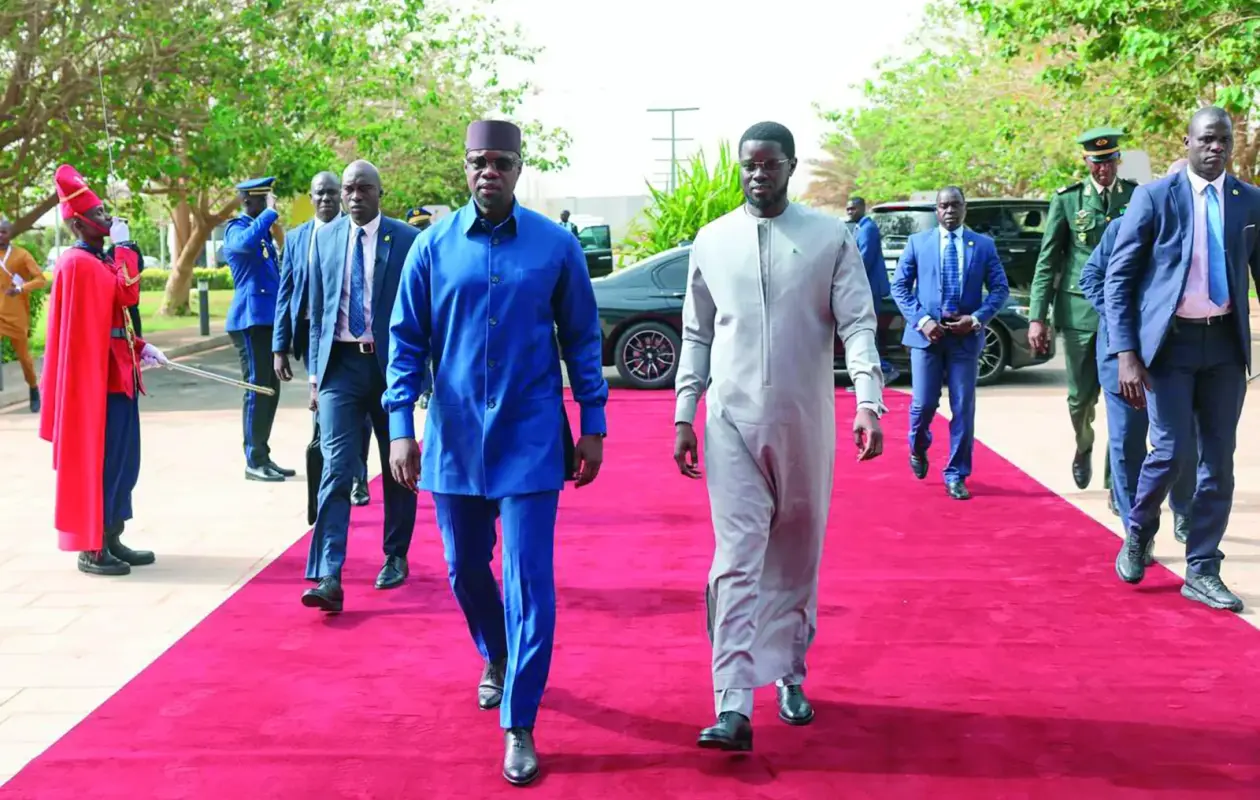
Bassirou Diomaye Faye et Ousmane Sonko
Bassirou Diomaye Faye and Ousmane Sonko, Senegal, 2026. Photograph source: Seneweb.
« Political friendship works relatively well while companions share the same struggle. Victory makes it harder: offices, responsibilities and the final word must then be distributed. »

The statement reaches deeper into Senegal’s recent political history. Bassirou Diomaye Faye and Ousmane Sonko were long presented as the two faces of a single project. Power changed that relationship.

A president who no longer wants to be second

In March 2024, Bassirou Diomaye Faye reached the presidency in exceptional circumstances. Ousmane Sonko, barred from standing, designated him as the substitute candidate. Both men left prison only days before the election. Diomaye Faye won in the first round.

The slogan ‘Diomaye mooy Sonko’ accompanied the campaign. It was intended to signal continuity between the two men and reassure an electorate that had initially placed its hopes in Ousmane Sonko. Once elected, Bassirou Diomaye Faye appointed him Prime Minister.

The break did not happen in a day

The disagreements gradually moved beyond the inner circle of power. Ousmane Sonko retained an independent political voice, sometimes more combative than the president’s. Differences emerged over the conduct of government, relations with certain international partners and the way to pursue the promised project of rupture.

Bassirou Diomaye Faye now gives his account: these disagreements eventually made it impossible to keep Sonko at the head of government. He notably rejects the idea that their separation was caused solely by the International Monetary Fund dossier.

Ousmane Sonko, for his part, disputes some interpretations of the rupture. The two former partners therefore do not necessarily tell the story of their separation in the same way. This disagreement about the disagreement is itself politically revealing.

KEY POINTS

A president who no longer wants to be second
In March 2024, Bassirou Diomaye Faye reached the presidency in exceptional circumstances. Ousmane Sonko, barred from standing, designated him as the substitute candidate. Both men left prison only days before the election. Diomaye Faye won in the first round.
The break did not happen in a day
The disagreements gradually moved beyond the inner circle of power. Ousmane Sonko retained an independent political voice, sometimes more combative than the president’s. Differences emerged over the conduct of government, relations with certain international partners and the way to pursue the promised project of rupture.
Macky Sall in the middle of the picture
At the United Nations General Assembly on 24 September, Bassirou Diomaye Faye formally renewed Senegal’s support for his predecessor’s candidacy for the post of UN Secretary-General. The gesture is institutional. A president may perfectly well support the international candidacy of a former head of state from an opposing political camp. Yet the symbolism is difficult to ignore.

Macky Sall in the middle of the picture

At the United Nations General Assembly on 24 September, Bassirou Diomaye Faye formally renewed Senegal’s support for his predecessor’s candidacy for the post of UN Secretary-General. The gesture is institutional. A president may perfectly well support the international candidacy of a former head of state from an opposing political camp. Yet the symbolism is difficult to ignore.

Bassirou Diomaye Faye was elected after an extremely harsh political confrontation with Macky Sall’s government. Both he and Ousmane Sonko were imprisoned. Two years later, the president publicly backs Macky Sall’s international candidacy while his alliance with Sonko has broken down.

This does not mean that Bassirou Diomaye Faye has joined his predecessor’s camp. It does show how much the exercise of presidential office can shift political relationships established before an election.

Can two politicians remain friends when one becomes president?

Ousmane Sonko occupied a singular position alongside Bassirou Diomaye Faye. He was not simply a Prime Minister appointed after a presidential victory, but a companion in struggle.

Politics has known many friendships that did not survive power. In Senegal itself, Léopold Sédar Senghor and Mamadou Dia built the first years of independence together. Their institutional confrontation in 1962 ended with Mamadou Dia’s arrest, conviction and long imprisonment.

France offers the very different example of Jacques Chirac and Édouard Balladur, long close before becoming rivals in the 1995 presidential election. The story of Thomas Sankara and Blaise Compaoré is far more tragic; any direct comparison with present-day Senegal would be historically unjustifiable. Fidel Castro and Ernesto Che Guevara offer another case: their geographical and political separation did not lead to a comparable confrontation.

These histories do not predict the story of Diomaye Faye and Sonko. They show something else: political friendship works relatively well while companions share the same struggle. It becomes much harder when victory distributes offices, responsibilities and the final word.

The Senegalese case has an additional peculiarity. The man who initially possessed the greater political strength is not the one who received the presidential mandate.

Their friendship could withstand many things. It now had to withstand a much harder question: when the two men disagree, which one must yield? Senegal’s institutions have already answered it. Senegalese politics has not yet fully done so.

ShareWhatsAppLinkedInFacebook
Mérisphère — Actualité← Previous article    Next article →