
Home › African Current Affairs & Politics › AFRICAN CURRENT AFFAIRS
AFRICAN CURRENT AFFAIRS
Sudan — War fractures the economy and weakens the currency
THE SUDANESE POUND IS TRADING AT AROUND 7,500 TO THE US DOLLAR ON THE PARALLEL MARKET IN AREAS CONTROLLED BY THE ARMY. TERRITORIAL FRAGMENTATION IS ERODING REVENUE, DISRUPTING ACCESS TO FOREIGN CURRENCY AND MAKING MONETARY STABILISATION INCREASINGLY DIFFICULT.
The dollar reaches 7,500 pounds on the parallel market
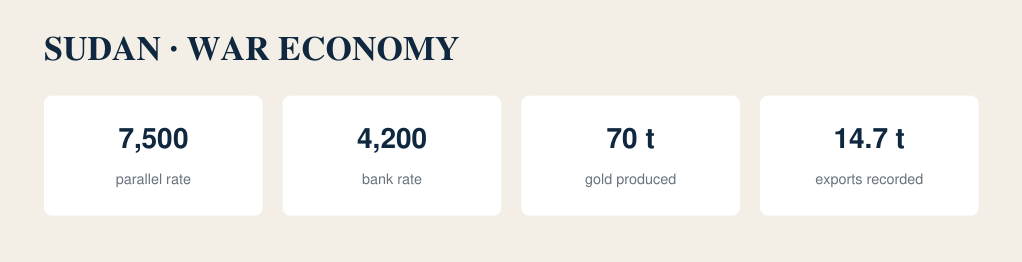
On 22 September, one US dollar was trading at around 7,500 Sudanese pounds on the parallel market, compared with roughly 4,100 in May and about 600 before the war. Bank of Khartoum, meanwhile, was quoting a rate close to 4,200. The gap reflects an economy in which access to foreign currency no longer operates through a single, coherent system.
Seventy tonnes produced, 14.7 tonnes of exports recorded
Official-sector figures put gold production at about 70 tonnes in 2025, while the central bank recorded only 14.7 tonnes of exports. The two series cannot simply be subtracted to produce an estimate of smuggling. They nevertheless reveal the scale of the gap between declared production and exports recorded by the monetary authorities.
Two zones of control, fragmented economic circuits
Areas controlled by the army and those held by the Rapid Support Forces no longer operate within the same commercial, fiscal and monetary circuits. A central bank cannot readily stabilise a currency when significant resources, borders and export flows fall outside a common administrative system. Monetary sovereignty in Sudan now depends as much on rebuilding a shared economic space as on the technical instruments of monetary policy.
AFRICAN CURRENT AFFAIRS
Sudan — War fractures the economy and weakens the currency
THE SUDANESE POUND IS TRADING AT AROUND 7,500 TO THE US DOLLAR ON THE PARALLEL MARKET IN AREAS CONTROLLED BY THE ARMY. TERRITORIAL FRAGMENTATION IS ERODING REVENUE, DISRUPTING ACCESS TO FOREIGN CURRENCY AND MAKING MONETARY STABILISATION INCREASINGLY DIFFICULT.
The dollar reaches 7,500 pounds on the parallel market
On 22 September, one US dollar was trading at around 7,500 Sudanese pounds on the parallel market, compared with roughly 4,100 in May and about 600 before the war. Bank of Khartoum, meanwhile, was quoting a rate close to 4,200. The gap reflects an economy in which access to foreign currency no longer operates through a single, coherent system.
Seventy tonnes produced, 14.7 tonnes of exports recorded
Official-sector figures put gold production at about 70 tonnes in 2025, while the central bank recorded only 14.7 tonnes of exports. The two series cannot simply be subtracted to produce an estimate of smuggling. They nevertheless reveal the scale of the gap between declared production and exports recorded by the monetary authorities.
Two zones of control, fragmented economic circuits
Areas controlled by the army and those held by the Rapid Support Forces no longer operate within the same commercial, fiscal and monetary circuits. A central bank cannot readily stabilise a currency when significant resources, borders and export flows fall outside a common administrative system. Monetary sovereignty in Sudan now depends as much on rebuilding a shared economic space as on the technical instruments of monetary policy.
Verification: Reuters, 22 September 2026. Causal explanations are kept distinct from exchange-rate and production data.