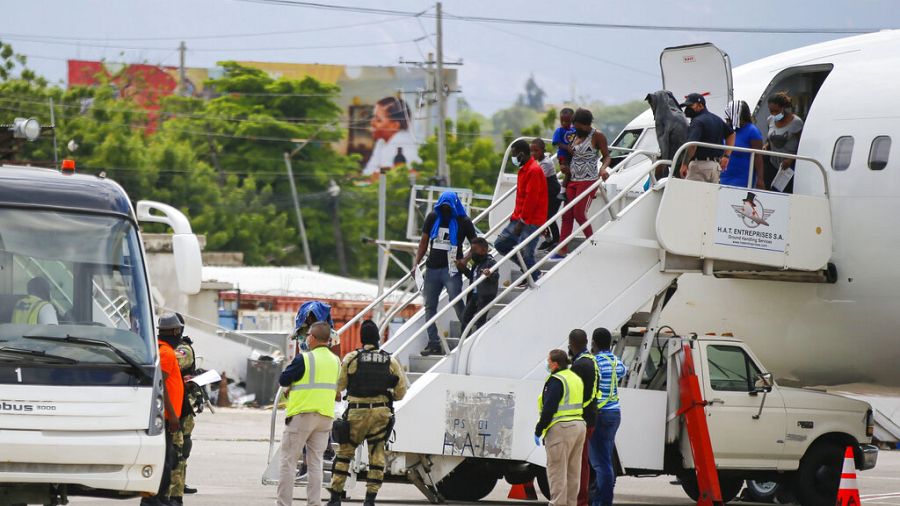
That has not prevented the United States from resuming deportations of Haitian nationals at a sustained pace. Following the end of Temporary Protected Status, deportation flights increased. From August 2026 onwards, US authorities transferred several hundred people to Cap-Haïtien. Human Rights Watch recorded five weekly flights between 20 August and 17 September, carrying 474 people; further flights followed.
While the word ‘return’ is legally accurate to describe sending a national back to their country of nationality, it is less adequate for some biographies. Among those deported are people who had long been settled in the United States, sometimes with a family, a job, an asylum application or other proceedings still under way. Haitian nationality guarantees neither housing, nor an available family network, nor the immediate ability to resettle.
Cap-Haïtien receives America’s long-lost cousins
Aircraft land in Cap-Haïtien because security conditions around Port-au-Prince make the capital’s airport difficult to use for these operations. The northern city has become a point of entry for people arriving in a country already facing a major humanitarian crisis.
By the end of September, the International Organisation for Migration estimated that nearly 1.5 million people were internally displaced in Haiti. Almost 80% were now outside Port-au-Prince, showing how violence had spread beyond the capital. Facilities receiving deportees have limited resources.
Human Rights Watch described a registration process in Cap-Haïtien carried out in modest facilities, with limited capacity to assess individual health problems, vulnerabilities or protection needs. Haitian officials have also pointed to the absence of a sufficiently resourced national system for long-term reintegration.
Difficulties sometimes begin before people have even left the airport. Some deportees arrive without their personal belongings or documents. Others must begin procedures to obtain civil-status and identity papers. Immediate assistance may be provided; it is no substitute for housing, an income or a durable resettlement policy.
One person interviewed in Cap-Haïtien by Human Rights Watch summed up the forced return starkly: having left Haiti to escape danger, the person was being sent back to a country where they no longer knew where to go. Others had lived in the United States for several years and were leaving behind relatives who were US citizens. On 27 August, deportees arrived without the personal belongings they had expected to recover at their destination. After registration, Haitian authorities gave them a meal, a drink and 10,000 gourdes before transferring them for further formalities.
A different violence that recalls the time of the ‘tontons’
The armed groups spreading terror in Haiti are not an institution identical to the tontons-macoutes. They nevertheless control territories, impose local rules, extract resources, commit kidnappings, sexual violence and killings, and can prevent movement between neighbourhoods or regions.
The parallel concerns the social experience of fear and domination, not the organisations' identities. The distinction matters all the more as the country attempts to rebuild public security capacity with the support of an international force whose mandate has just been renewed.
Returning Haitian nationals in this context does not mean every one of them will be directly threatened on arrival, but it does mean the receiving state must absorb them at the very moment it is struggling to protect and assist a very large displaced population.
A diaspora caught between two allegiances
The Haitian diaspora in the United States is not a legally homogeneous group. US citizens, permanent residents, current or former TPS beneficiaries, asylum seekers, people admitted under other humanitarian programmes and foreign nationals subject to removal do not have the same rights.
The end of TPS has brought this diversity into sharper focus. It has also revealed the distance that can exist between nationality and the life actually lived. A person may be legally Haitian while having spent most of their adult life in the United States. Their children may attend school there or be US citizens. Their income, home and family network may be there.
If deportation settles the question of the right to remain in the United States, it does not resolve the question of resettlement in Haiti.