
Home › African Current Affairs & Politics › AFRICAN CURRENT AFFAIRS
AFRICAN CURRENT AFFAIRS
Nigeria — Thirty-seven die in custody in Minna as cause of death remains unestablished
AROUND 37 PEOPLE SUSPECTED OF INVOLVEMENT IN ARTISANAL MINING DIED AFTER BEING TAKEN INTO CUSTODY IN MINNA, NIGER STATE. NIGERIA’S NATIONAL HUMAN RIGHTS COMMISSION IS CALLING FOR INDEPENDENT FORENSIC POST-MORTEM EXAMINATIONS AND THE PRESERVATION OF EVIDENCE.
Thirty-seven detainees die following arrests
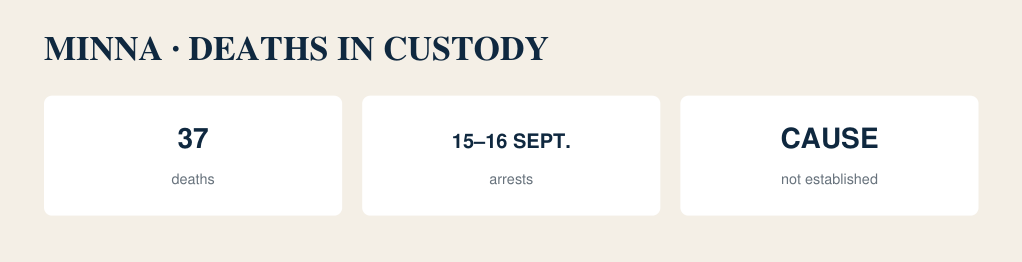
The individuals concerned were arrested on 15 and 16 September during operations in the Wushishi–Lukoto area. Their bodies were subsequently taken to Minna General Hospital. Nigeria’s National Human Rights Commission has opened a preliminary investigation. At this stage, the cause of death has not been publicly established.
NHRC calls for independent post-mortem examinations
The gravity of the case makes factual precision more, not less, important. The deaths in custody are established. Criminal responsibility on the part of particular individuals or services is not. The Commission has called for independent post-mortem examinations, the preservation of all physical evidence and a transparent investigation. These measures should help establish the conditions of detention, the chronology of the deaths and any resulting responsibility.
Custody places a public duty on the state
Combating illegal mining is a public responsibility. It does not suspend the safeguards owed to anyone held by the state. Once a public authority deprives a person of liberty, it assumes responsibility for that person’s safety and for the integrity of the procedures that follow the arrest. The Minna case therefore touches on a practical dimension of sovereignty. Public authority is measured not only by its capacity to intervene at a mining site, but also by its ability to account for the use of coercive power and to conduct a credible investigation when people die in its custody.
AFRICAN CURRENT AFFAIRS
Nigeria — Thirty-seven die in custody in Minna as cause of death remains unestablished
AROUND 37 PEOPLE SUSPECTED OF INVOLVEMENT IN ARTISANAL MINING DIED AFTER BEING TAKEN INTO CUSTODY IN MINNA, NIGER STATE. NIGERIA’S NATIONAL HUMAN RIGHTS COMMISSION IS CALLING FOR INDEPENDENT FORENSIC POST-MORTEM EXAMINATIONS AND THE PRESERVATION OF EVIDENCE.
Thirty-seven detainees die following arrests
The individuals concerned were arrested on 15 and 16 September during operations in the Wushishi–Lukoto area. Their bodies were subsequently taken to Minna General Hospital. Nigeria’s National Human Rights Commission has opened a preliminary investigation. At this stage, the cause of death has not been publicly established.
NHRC calls for independent post-mortem examinations
The gravity of the case makes factual precision more, not less, important. The deaths in custody are established. Criminal responsibility on the part of particular individuals or services is not. The Commission has called for independent post-mortem examinations, the preservation of all physical evidence and a transparent investigation. These measures should help establish the conditions of detention, the chronology of the deaths and any resulting responsibility.
Custody places a public duty on the state
Combating illegal mining is a public responsibility. It does not suspend the safeguards owed to anyone held by the state. Once a public authority deprives a person of liberty, it assumes responsibility for that person’s safety and for the integrity of the procedures that follow the arrest. The Minna case therefore touches on a practical dimension of sovereignty. Public authority is measured not only by its capacity to intervene at a mining site, but also by its ability to account for the use of coercive power and to conduct a credible investigation when people die in its custody.
Verification: National Human Rights Commission of Nigeria, statement published on 18 September 2026.