Africa in 1956 remained largely colonised. Tunisia and Morocco had just gained independence; the Algerian War was under way; Ghana was not yet independent. Haiti had been independent since 1804. Martinique and Guadeloupe had been French departments for ten years. In the United States, segregation still structured the lives of millions of African Americans. The same word, emancipation, did not designate the same task everywhere.
Disagreements we no longer remember
Senghor sought the foundations of a Negro-African culture and conceived a dialogue of civilisations. Césaire directly connected culture and colonisation. Fanon examined how racism changed and became embedded in social and cultural structures. Jacques Stéphen Alexis spoke from Haiti, an independent country nonetheless traversed by its own relations of domination.
Richard Wright brought the African-American experience and observed anti-colonial nationalisms with an attentiveness that did not shy away from criticism. Disagreements over culture, race, class, the universal, Marxism, assimilation and independence were not peripheral accidents of the Congress. They belonged to its substance.
The year 1956 sharpened some of these dividing lines. A few weeks after the Congress, Césaire addressed his Letter to Maurice Thorez and left the French Communist Party. Fanon was already engaged in the Algerian War. Four years later, Senghor became the first president of independent Senegal. The Sorbonne discussions did not remain confined to the amphitheatre.
Before 1956, the Black Atlantic was already intellectually charged
The Congress did not create the conversation between Africa, the Caribbean, and the Americas from nothing. Marcus Garvey, W. E. B. Du Bois, Pan-African movements, the Harlem Renaissance, the Nardal sisters and the journal Présence Africaine had already established networks of intellectual and political circulation.
Paris occupied a particular place in this geography. Students, writers and activists from the French colonies, the Caribbean, Africa and the United States met there. Languages, empires and historical experiences separated them as much as they brought them together.
This history explained why the Congress could bring participants together without producing a common doctrine. Its importance also lay in making disagreements visible within a shared space.
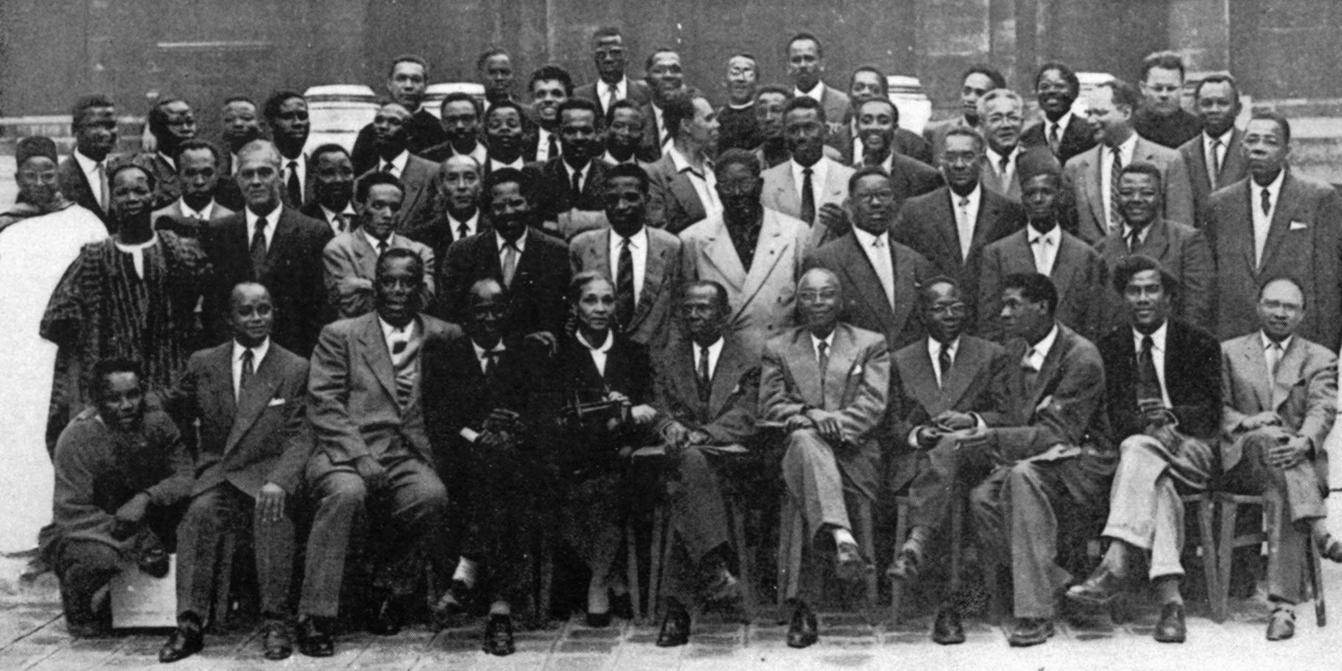
A woman in the photograph
The Congress's composition nevertheless revealed the limits of that space. Women were very few among the visible delegates, and the major voices retained in the memory of the event were almost exclusively male.
This absence contrasted with the earlier role played by intellectuals such as Paulette and Jane Nardal in exchanges between francophone and anglophone Black worlds. It invites us to reread the history of the Congress by also looking at those — and especially those women — who made certain conversations possible without occupying the same place in the official photograph.
Seventy years later, a commemoration that merely reproduced the canonical list of great men would miss part of the intellectual history it claims to celebrate.
The pioneers’ works do not circulate in the same way today
Independence multiplied states, universities, publishing houses and literary scenes. It did not create a unified Black cultural space.
Césaire and Fanon remain widely read in many African countries. Senghor belongs to both Senegal’s literary and political history. Glissant has acquired considerable international reach. Other writers circulate much more unevenly. Jacques Stéphen Alexis, Damas, and certain anglophone, lusophone, and Creole-speaking intellectual traditions remain less present, depending on the country and education system.
Circulation also works in the other direction. Contemporary African literatures are visible in the Caribbean and the diasporas, but conversations no longer pass through a single centre. London, Lagos, Dakar, Kinshasa, Paris, Montreal, New York, Port-au-Prince and Fort-de-France belong to different networks traversed by English, French, Portuguese and Creole languages.
A legacy
The First Congress left behind no single doctrine. It left works, archives and controversies. They still allow experiences, made more numerous and more diverse by seventy years of independence, migration, and creation, to be brought into conversation.