Learning without forgetting?
“Learning without forgetting” does not refer only to preserving a threatened identity. Learning introduces concepts, methods and new ways of distinguishing true from false, useful from useless, possible from impossible. Knowledge transforms habits of judgement as much as it increases what is known.
Samba Diallo experiences this even in his relationship with himself. The new school has not merely educated him. It has displaced his relationship with himself, with his world and with what he believed he could remain.
His tragedy therefore does not arise from two cultures placed before him like two roads between which he must choose. Those two worlds have ceased to be external to him. They are now within him.
After independence, Samba Diallo’s existential experience ceased to belong to a single subject: to varying degrees, it became a social condition of African societies.
African countries have trained generations of lawyers, doctors, engineers, economists, philosophers, administrators, agronomists, teachers and political scientists. These elites have led administrations, universities, parts of national economies and the states themselves.
Access to knowledge is therefore no longer the main problem; the issue is what that knowledge becomes when it enters a society.
Seen in this light, Samba Diallo’s ambiguity announces something larger than his own inner division.
The “Black Toubab”
Guardians of the Temple carries the problem of ambiguous adventure into the political order. The coloniser has left. The institutions remain, together with elites trained in the new school, populations attached to other forms of legitimacy, and a state required to hold together inheritances whose compatibility is far from self-evident.
The fracture that ran through Samba Diallo now runs through the state. An administration, a constitution, courts and borders are not enough to give a society the sense that the state is truly its own. Institutions must also be recognised by those in whose name they act.
Jérémie Laskol, the first president of the young Republic, this Westernised “Black Toubab”, governs a society whose workings he no longer fully understands. His difficulty is not merely personal. It lies in the distance between the categories through which he thinks about society and those through which society understands itself.
Another path is possible, however: that of Salif Bâ. He too attended the modern school. An agricultural engineer who became a governor, he works with farmers and with the knowledge already present in their environment.
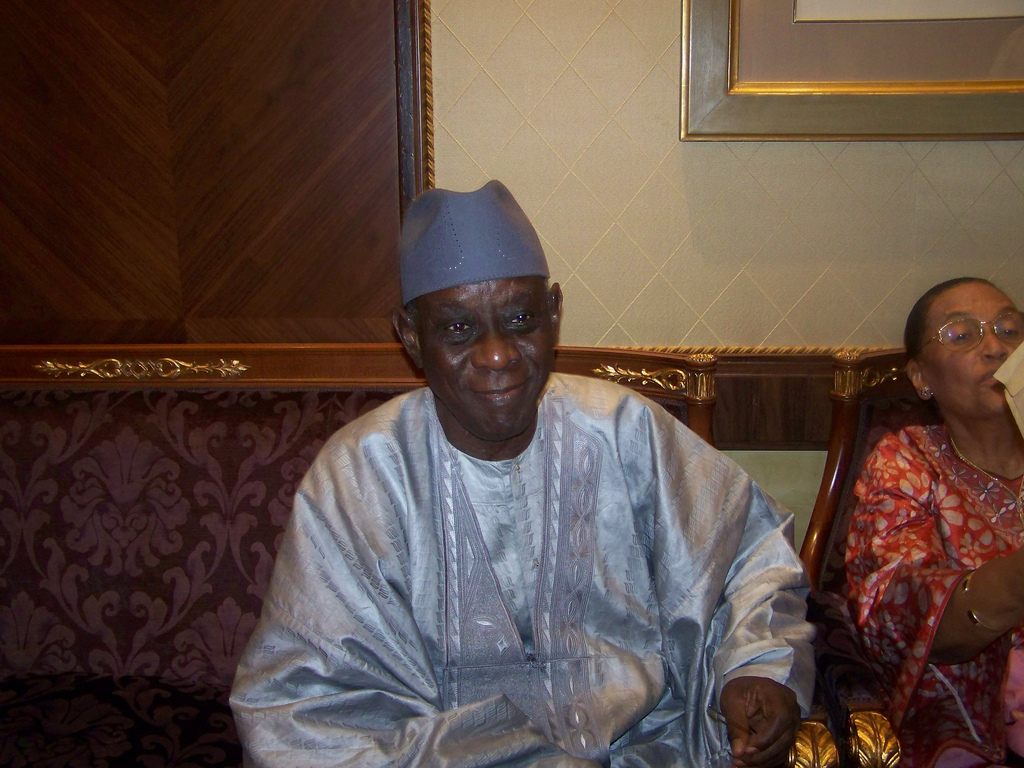
Cheikh Hamidou Kane himself established the link between the two characters. In December 2013, in an interview with Ousseynou Nar Gueye for the Brussels magazine Notre Afrik, a few days after Nelson Mandela’s death, he explained that Samba Diallo’s disappearance did not mean that he considered synthesis impossible. Samba, he said, had lost neither his Muslim faith nor his faith in Black culture; his path had been interrupted by death.
It was notably for this reason that he had considered it necessary to write Guardians of the Temple. Salif Bâ, a Muslim Fulani like Samba Diallo, rooted in his cultural values and, like him, educated to university level, had followed the other possible path: “He came back, committed himself, worked, lived.” Nations SN
Asked which of his two novels he would associate with Mandela, Kane therefore chose Guardians of the Temple. Mandela had studied, waged the political struggle, exercised power and then left the presidency after one term. He had become, in Kane’s words, “a national conscience”. His conclusion was brief: “He truly is the guardian of the temple.” Nations SN
The expression has a particular resonance today. The guardian of the temple is not the person who forbids any openness to elsewhere, but the one who passes through the encounter without surrendering to the other the determination of what he ought to become.
Recent upheavals in the Sahel provide a contemporary illustration. A country may be administered by its own nationals and nevertheless experience a profound distance between its institutions and part of society.
Kane placed that distance in his characters. Postcolonial history installed it in the state.
From knowledge to power
The world in which Cheikh Hamidou Kane disappears is no longer the one in which Ambiguous Adventure was born.
The post-Cold War period had fostered the hope of an order gradually pacified by trade, economic interdependence and the extension of common norms. Technology, energy, supply chains, sea routes, strategic minerals, infrastructure and military alliances have once again become explicit instruments of power.
Africa is once again at the centre of these rivalries. Cobalt, copper, lithium, manganese, graphite and other resources essential to energy and digital transitions attract China, Russia, the United States, Europe, the Gulf states and other actors. Ports, trade corridors, maritime frontages and markets add to this geography of resources.
Ambiguous Adventure explains that the Grande Royale accepted the new school only because she believed the Diallobé could not evade the world coming towards them. She wanted their children to learn what had enabled the victor to defeat them.
On one point, the historical situation has reversed. In Samba Diallo’s time, the instruments of power had to be sought from the other. Today, Africa possesses part of the resources that major powers need for their industries, technologies and energy transitions.
Possession alone guarantees nothing. A resource does not become power merely because it lies underground. Everything depends on the capacity to influence the conditions of its extraction, transformation, circulation and sale.
A new anxiety for Africa in a world that has radically changed
In 1993, and later in The Clash of Civilizations and the Remaking of World Order in 1996, Samuel Huntington proposed a reading of the post-Cold War world in which cultural and civilisational affiliations would take on growing importance in international conflicts.
The thesis prompted many objections. Civilisations are less homogeneous than such a representation suggests, and some of the most violent wars cut across populations that this typology places within the same group. State interests rarely follow such clear cultural boundaries.
Kane located the encounter between worlds elsewhere. In his work, the frontier first runs through the human being. Samba Diallo inhabits the middle. Demba can remain within the certainty of a world he has not left. Samba Diallo cannot. He does not stand before two cultures foreign to him. Both have become constitutive of his experience.
Huntington needed civilisations stable enough to conceptualise their confrontation. Kane shows a man in whom the frontier has already lost its sharpness.
This difference may explain why Ambiguous Adventure has aged better. People now move between societies that are themselves changing as they cross them. One does not necessarily leave a stable world to enter another that is any more stable.
Samba Diallo’s ambiguity therefore no longer belongs only to the African experience of the first decades of decolonisation. It belongs to a world in which one may be formed by several inheritances without any one of them being able, by itself, to constitute a permanent home.
Cheikh Hamidou Kane thus leaves a question broader than that of the new school: how can we receive what transforms us without surrendering to others the power to decide what we ought to become?